





A 3D printed interlocking electrode kills dead zones. More storage, faster charging, and 7,500 cycles later, without changing the material itself.
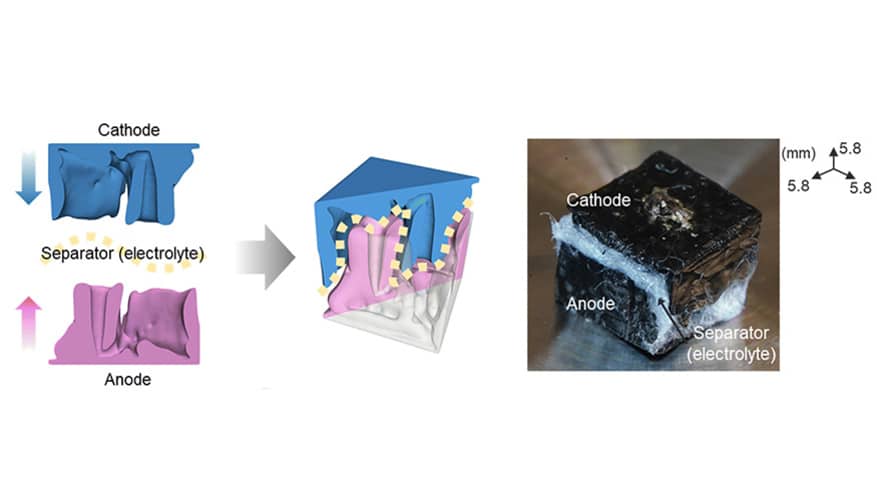
A research team led by engineers and scientists at Lawrence Livermore National Laboratory (LLNL) has developed a 3D printed electrode design aimed at improving electrochemical energy storage devices such as rechargeable batteries and supercapacitors. The work, published in Materials Horizons, demonstrates how design optimization combined with additive manufacturing can help balance energy storage capacity and charging performance.
The team designed a 5.8 millimetre ultra thick device using two interlocking electrodes that maximize active material while improving ion and electron transport. Conventional thick electrodes can increase storage capacity, but they often slow ion movement, limiting charging speed and power delivery. The design addresses this trade-off through optimized geometry rather than changes to the electrode material itself.
A major advantage of the interlocking structure is the reduction of “dead zones,” where battery material remains underutilized because ions cannot efficiently reach deeper regions. The interdigitated electrode layout increases surface area and creates multiple pathways for ion transport, helping improve charge distribution and reduce resistive losses.
The researchers used computational optimization to explore complex electrode geometries that would be difficult to design manually. The electrodes were then fabricated using multi material micro stereolithography, with porous graphene oxide layers supporting ion transport and a gold coating added to improve conductivity.
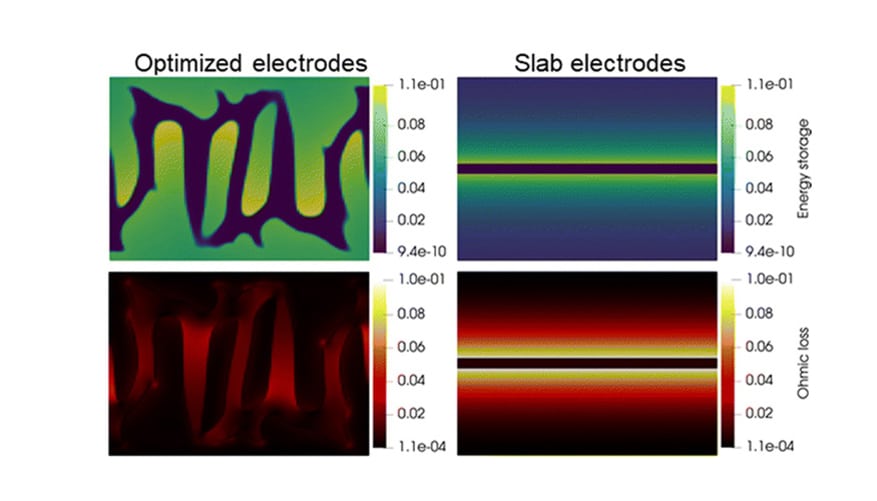
In testing, the optimized electrodes outperformed conventional 2D designs and existing 3D printed carbon based supercapacitors. The device demonstrated improved capacitance, better energy storage performance, lower resistance, and operational stability over more than 7,500 charge discharge cycles.
The team plans to extend the optimization framework to applications including lithium ion batteries, stretchable batteries, electrochemical flow batteries, and large scale energy storage manufacturing.
“The real breakthrough is not one component in isolation, it is the integration,” says Physics and Life Sciences researcher Marcus Worsley. “The interdisciplinary nature of the project demonstrates how our team and LLNL are uniquely positioned to tackle such collaborative projects and complex problems.”

