






What if scientists could study fusion and matter inside stars in less time? A new computing method may change how X-ray experiments are analyzed.
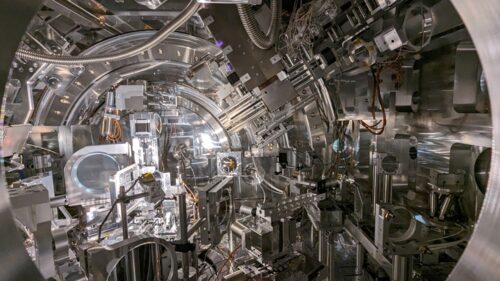
Scientists at Helmholtz-Zentrum Dresden-Rossendorf have developed a computational method that could reduce the time needed to analyze experiments at the European XFEL, a step that may accelerate research into fusion energy and states of matter.
The new approach can make simulations run up to 50 times faster while maintaining the accuracy needed to interpret data from the European XFEL. The method is expected to improve studies of matter exposed to temperatures and pressures similar to those found inside stars, planets, and fusion experiments.
The challenge facing researchers is not generating the experimental data itself, but decoding it. In X-ray scattering experiments, X-ray pulses are fired through matter, and scientists study how the rays scatter to determine properties such as density, temperature, and conductivity. But translating those scattering patterns into measurements requires demanding computer simulations.
Researchers typically run thousands of simulations with different temperature and density combinations until the results match experimental observations. At high temperatures, the calculations become more difficult because they must account for a large number of quantum mechanical states while filtering out numerical distortions that can affect the results.
The new method addresses that bottleneck by separating physical signals from numerical noise produced during simulations. According to the team, the approach relies on a mathematical transformation into “imaginary time,” a concept used in quantum mechanics that is tied to temperature calculations.
In benchmark tests, the researchers found that simulations could be completed up to 50 times faster. That improvement would allow scientists to perform broader parameter scans and analyze experimental data with greater precision.
The advance could have implications beyond fusion research. Facilities like the European XFEL are also used to recreate conditions similar to those inside planets and stars, making them tools for laboratory astrophysics. Faster simulations could help researchers calculate material properties — including electrical conductivity and radiation absorption — more efficiently and accurately.
Researchers believe it could eventually evolve into a computational tool for interpreting high-energy X-ray experiments and studying matter under extreme conditions.


