What if future computers could run faster while using less power? A light-based device may bring that future closer than expected.
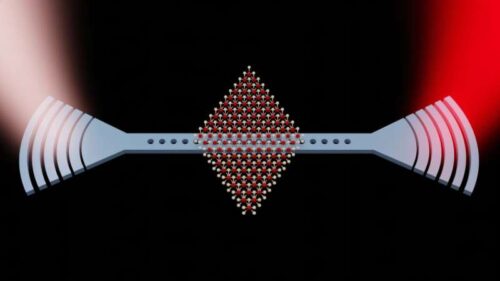
Researchers at the University of Pennsylvania and Montana State University have developed a photonic device capable of switching light signals using low amounts of energy, marking a step toward all-optical computing. The system, described in a paper published in Physical Review Letters, uses a two-dimensional semiconductor material known as Molybdenum Diselenide combined with a photonic crystal nanocavity to enable interactions between light particles.
The device achieved optical switching at energy levels of roughly four femtojoules, among the lowest reported for such systems. The researchers believe the approach could support the development of faster and more energy-efficient computing technologies, including artificial intelligence hardware, neuromorphic systems, and future quantum computing platforms.
Photonic devices process information using light instead of electricity. Because photons travel faster and generate less heat than electrons, photonic systems are considered an alternative to electronic chips. However, one of the field’s challenges has been enabling photons to interact strongly enough with one another to perform logic operations and computations.
To address this problem, the researchers turned to exciton-polaritons, hybrid quasiparticles formed when photons couple with excitons—bound electron-hole pairs found in semiconductors. These quasiparticles combine the speed of light with the interaction properties of matter, making them suitable for low-energy optical switching.
The team created these exciton-polaritons by coupling light confined inside a silicon nitride nanobeam cavity with excitons in a monolayer of MoSe₂. The nanocavity acted as a small light trap, confining the particles and enhancing their interactions.
The work also demonstrated that 2D semiconductor materials can be integrated with nanoengineered photonic structures using fabrication methods. This compatibility with manufacturing techniques could allow future photonic chips to contain thousands of interconnected optical components operating on a single platform.
The researchers said the current switching threshold is not a fundamental limit and could potentially be reduced through further optimization. They are now exploring methods to reach the quantum regime, where a single photon could control another photon directly.
The team is also investigating on-chip integration strategies that would connect multiple nanocavities into optical circuits, paving the way for optical processors capable of fast and energy-efficient computation.