Researchers at the University of Florida have created a silicon photonic chip that uses light to perform AI computations, cutting energy use by up to 100-fold while maintaining high accuracy.
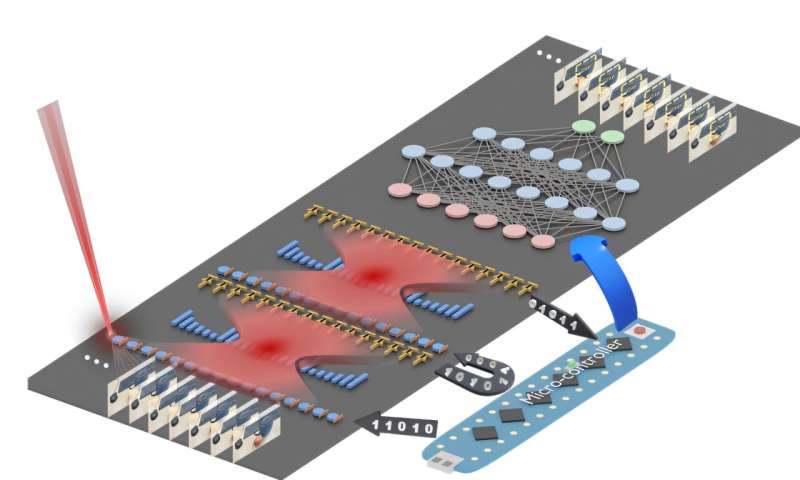
Artificial intelligence is advancing rapidly, but its growing power needs are becoming a critical challenge. A team at the University of Florida has developed a new silicon photonic chip that could dramatically ease this burden. By using laser light instead of only electricity, the chip performs convolution operations—the core pattern-recognition step in AI models—with up to 100 times higher efficiency than conventional chips. This leap forward addresses one of the most power-hungry aspects of machine learning, offering a sustainable path for scaling AI.
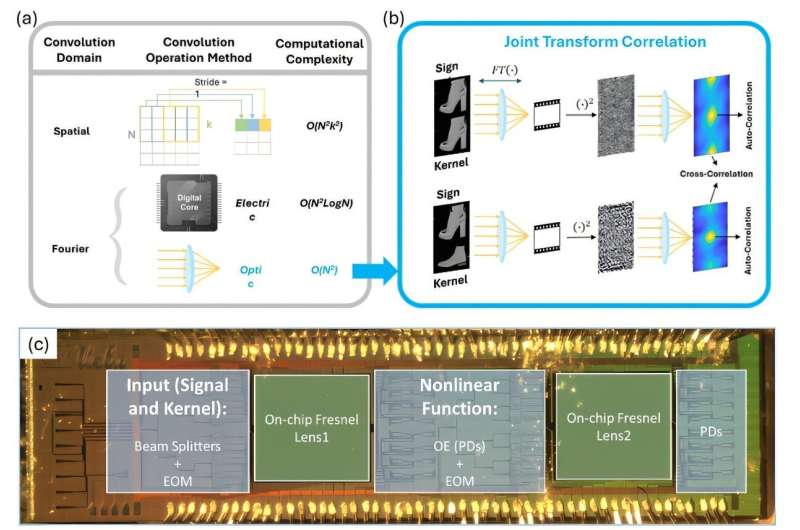
The innovation lies in integrating ultrathin Fresnel lenses directly onto silicon, enabling optical convolutions on-chip. Input data is converted into light, processed as it passes through the lenses, and then transformed back into digital signals. Early tests show the prototype achieving about 98% accuracy in classifying handwritten digits, matching traditional electronic chips but at near-zero energy cost. Beyond efficiency, the chip also supports wavelength multiplexing—allowing multiple data streams to be processed simultaneously using different colors of laser light, a capability unique to photonics.
With AI’s electricity demands projected to soar, the implications are significant. Chipmakers already experimenting with photonic components, like NVIDIA, could adopt this approach to build greener, faster AI hardware. Optical AI computing is poised to become a standard feature of future chips, making sustainable high-performance AI a reality.
“Performing a key machine learning computation at near zero energy is a leap forward for future AI systems,” said Volker J. Sorger, Rhines Endowed Professor at the University of Florida. His colleague Hangbo Yang emphasized that this marks the first time optical convolution has been directly applied to a neural network on a chip.