Drones struggle with battery limits and visibility—this ultrasound system tackles both, enabling navigation in fog, darkness, and smoke while extending flight time.
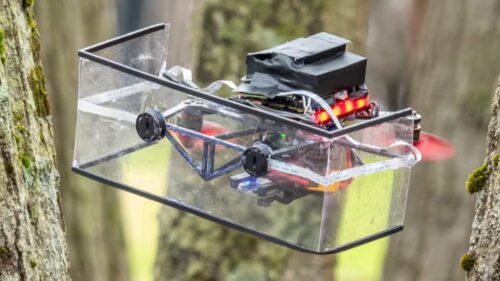
Researchers at Worcester Polytechnic Institute developed a sensing system that uses ultrasound and an artificial intelligence algorithm to help drones navigate with low power and detect surroundings through fog, smoke, and other visual obstructions. Quadcopter drones drain batteries rapidly, limiting flight time, as propellers consume most of the energy while sensors used for navigation also draw significant power. Developing efficient sensing systems can help keep drones in the air for longer.
The research focuses on enabling small, palm-sized aerial robots to operate in environments that would defeat navigation systems. Cameras and lidar, for example, struggle in darkness or poor weather, while radar systems are often too bulky and power-hungry for lightweight drones.
To overcome these limitations, the team developed a system called “Saranga,” which relies on two ultrasound sensors. Like bats emitting chirps and interpreting echoes, the drone sends out sound waves and analyzes the returning signals to detect obstacles. However, interpreting these echoes is challenging due to interference from the drone’s propellers. To address this, the researchers added an acoustic shield to block noise and trained a deep learning model to extract patterns from noisy data.
The result is a sensing system that consumes about 1.2 milliwatts of power — lower than traditional approaches. This low power requirement is important for small drones with limited battery capacity, where every milliwatt saved can translate into longer flight times.
In testing, the team equipped a quadrotor drone, about six inches across and weighing around one pound, with the system. The drone navigated indoor and outdoor obstacle courses, including environments with fog, darkness, and artificial snow. Across 180 trials, it achieved success rates ranging from 72% to 100%, showing performance under these conditions.
However, there were some limitations. The system struggled to detect very thin objects, such as narrow metal poles or small tree branches, which reflect weak ultrasound signals. Even so, the results mark a step forward in autonomous navigation for small aerial robots.
Looking ahead, the researchers plan to further miniaturize the system and improve flight speed and endurance.