




A new low-power wireless module combines Wi-Fi 6, Bluetooth Low Energy and integrated processing to simplify connected device development across industrial and consumer applications.
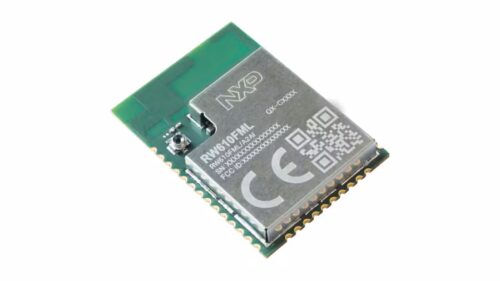
NXP Semiconductors has introduced the RW610FML, a low-power wireless communication module designed for Internet of Things (IoT) devices. The pre-production module combines Wi-Fi 6 and Bluetooth Low Energy (BLE) connectivity with an integrated Arm Cortex-M33 processor, allowing it to function either as a dedicated communications coprocessor or as the primary controller for connected hardware.
Built around the RW610 system-on-chip, the module features a single 260MHz Arm Cortex-M33 core, 1.2MB of on-chip static random access memory (SRAM) and support for execute-in-place (XIP) from external flash or the integrated 8MB flash memory. It also supports optional pseudo-static RAM expansion through a secondary serial peripheral interface (SPI), providing developers with greater flexibility for memory-intensive applications.
For wireless connectivity, the module includes dual-band 2.4GHz and 5GHz Wi-Fi 6 operating in a 1×1 configuration with channel widths up to 20MHz and peak data rates of 114Mb/s. The integrated BLE radio supports transfer speeds of up to 2Mb/s, making the module suitable for battery-powered IoT devices requiring efficient wireless communication.
The RW610FML also offers a broad range of peripheral interfaces, including SDIO 3.0, USB, UART, I²C, SPI, I²S, LCD and microphone interfaces, along with analogue-to-digital and digital-to-analogue converters, analogue comparators, GPIO, PWM and debugging support through JTAG and Serial Wire Debug. These features enable integration across industrial automation, smart home equipment and consumer electronics.
Alongside the module, NXP Semiconductors has launched the FRDM-RW610FML development board, giving engineers immediate access to the module’s peripheral interfaces for evaluation and prototyping. While the hardware is currently in pre-production and pricing has not yet been disclosed, the platform is intended to accelerate development of next-generation low-power connected devices.
Click here to view the original announcement.


