




The magnetic material changes stiffness and shape without changing parts, opening possibilities in robotics, medicine, sports, and safety gear.
Scientists from Universidad Carlos III de Madrid (UC3M) and Harvard University have shown through experiments that the mechanical and structural behavior of magnetic metamaterials can be reprogrammed without changing their composition. This breakthrough could lead to new advances in areas like biomedicine and soft robotics.
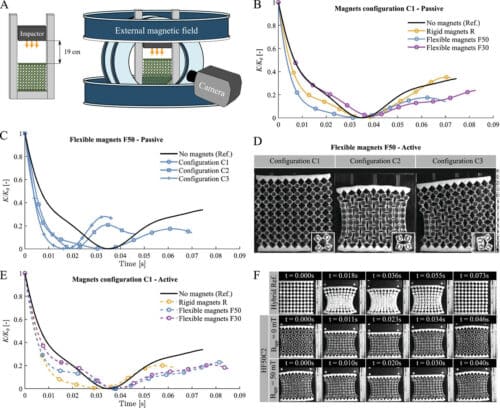
The innovation lies in the use of small flexible magnets embedded within a rotating rhomboid matrix, enabling changes in the material’s stiffness and energy absorption simply by adjusting the magnet distribution or applying an external magnetic field. This approach gives the material unique properties not found in conventional materials or in nature.
Typically, material design focuses on chemical composition and microstructure. However, with metamaterials, it is also possible to manipulate internal geometry and spatial arrangement to achieve new functionalities.
This advancement marks a significant step toward developing reconfigurable mechanical structures, with potential uses in robotics, impact protection, and aerospace engineering. According to the researchers, the possible applications of these metastructures are virtually limitless.
These materials could be used in impact protection structures, adaptive components in soft robotics, and intelligent shock-absorbing systems in exoskeletons. In sports, they offer the potential to adjust the mechanical response of a shoe sole by modifying the interactions of embedded elements, making specific areas more flexible or rigid to enhance a person’s or runner’s footfall.
In biomedicine, they could enable new treatments—such as modifying the structure within a blocked blood vessel and using an external magnetic field to expand the material and clear the blockage.
The study combined the identification and characterization of various materials with an analysis of their behavior under different magnetic orientations.
Researchers examined how magnet orientation, residual magnetization, and rigidity influence the static and dynamic responses of the metamaterial. Their findings showed that precise reorientation of the magnets can significantly alter the material’s behavior. They also explored how these materials could be integrated into larger structures for dynamic impact testing.
By adjusting the position of the magnets to control their interactions, the material was shown to exhibit entirely different mechanical responses.
Reference: Carlos Perez‐Garcia et al, Reprogrammable Mechanical Metamaterials via Passive and Active Magnetic Interactions, Advanced Materials (2025). DOI: 10.1002/adma.202412353

