

A new multi-sensor camera tracking system enables stable marker-free positioning for augmented reality, virtual production, broadcast and cinematic workflows indoors and outdoors.
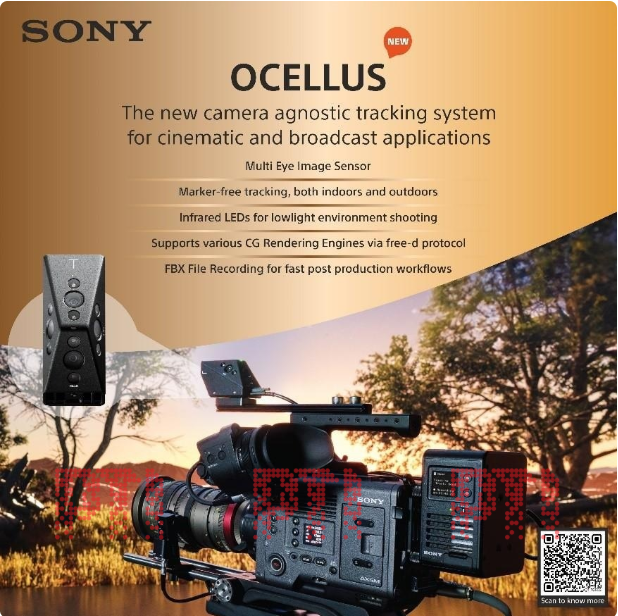
Creating realistic augmented reality (AR) graphics and in-camera visual effects requires highly accurate information about where a camera is positioned and how it moves. Sony India has introduced the OCELLUS ASR-CT1, a camera tracking system designed to provide this spatial data without requiring physical markers in the production environment.
The camera-agnostic system is aimed at virtual production, in-camera VFX, AR broadcasting and other cinematic and live-production applications. Potential uses include sports broadcasts, news studios, weather presentations and film production, where virtual graphics or computer-generated environments must remain accurately aligned with the camera’s movement.
At the centre of the system is a compact sensor unit equipped with five image sensors and Sony’s Visual SLAM (Simultaneous Localization and Mapping) technology. The technology creates a reference map of the surrounding environment, allowing the system to determine camera position and orientation while shooting. Four of the sensors are used for tracking, helping maintain operation even when parts of the scene are temporarily obstructed.
The key features are:
- Five-image-sensor Visual SLAM architecture
- Compact 250g sensor unit for camera rigs
- Real-time free-d data output over Ethernet
- FBX tracking-data recording on SDXC cards
- Interchangeable lens gears for wider lens compatibility
The marker-free approach can simplify production setups by eliminating the need to install dedicated tracking markers around a location. OCELLUS is designed to operate both indoors and outdoors, while IR LEDs and a Visible Light Cut Unit help improve tracking performance in low-light and changing lighting conditions.
The system consists of the sensor unit, a processing box, and three lens encoders. It can work with Sony Cinema Line cameras, Sony system cameras and cameras from other manufacturers. For compatible Sony cameras, focus, iris, and zoom metadata can be extracted through the SDI output. Lens encoders can capture these parameters when such metadata is unavailable directly from the camera.
The processing box transmits tracking and camera/lens metadata in real time to external CG rendering software, including Unreal Engine, through Ethernet using the free-d format. This enables virtual graphics and environments to respond to camera movement during production.
For post-production, the system can also record tracking information, camera and lens metadata, timecode and file information as FBX files on SDXC cards. By combining real-time tracking with recorded production data, the OCELLUS ASR-CT1 is designed to support spatial-content workflows from live production through post-production.