





Ice that melts and moves on its own? Tiny grooves make it possible, showing new ways to power, move, and clear without motors or pumps.
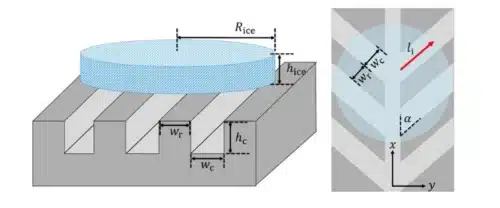
Researchers at Virginia Tech have shown that melting ice can propel itself, offering a possible new way to generate motion and even electricity without motors or pumps. The study demonstrates how controlled surface patterns can turn a basic phase change, in which ice melts into water, into steady, directed movement.
The system works with aluminum plates etched with tiny V-shaped grooves arranged in a herringbone pattern. When an ice disk melts on the surface, the water flows through the grooves. Because the grooves guide the flow in one main direction, they create a forward push, like a microscopic ratchet. This steady push makes the ice disk move on its own.
In experiments, the disks usually moved at a few millimeters per second. On surfaces coated to repel water, however, the disks sometimes slipped forward in sudden bursts. In these cases, meltwater collected under the ice until it broke free, causing rapid motion. This shows that groove design, surface chemistry, and temperature can all be tuned to control speed or force.
By arranging the grooves in a circular pattern, the researchers made the melting ice disk spin continuously. If linked to magnets or small turbines, this spinning motion could generate electricity without motors or pumps. The principle is similar to hydroelectric power, but instead of rivers, it uses melting ice guided by engineered surfaces. In cold regions or industrial sites where ice naturally forms, such systems could provide small, low-maintenance renewable energy sources.
The study also points to uses beyond electricity. In aerospace and infrastructure, self-propelled melting could be used for passive ice removal, clearing surfaces without heaters or scrapers. In microfluidic systems, the same principle could replace pumps, enabling droplet transport powered only by melting or condensation. In self-cleaning coatings, ice could automatically shed from critical areas as it propels itself.
Scaling up the system will not be easy. The grooves must be fabricated with very high precision, and producing useful amounts of energy would require larger surfaces and careful control of heat. Even so, this is the first proof that ice can propel itself.

