




Next-generation fault insertion units harness MEMS technology to boost bandwidth, accelerate switching, and extend operational life for MultiGBASE-T1 automotive and industrial Ethernet verification.
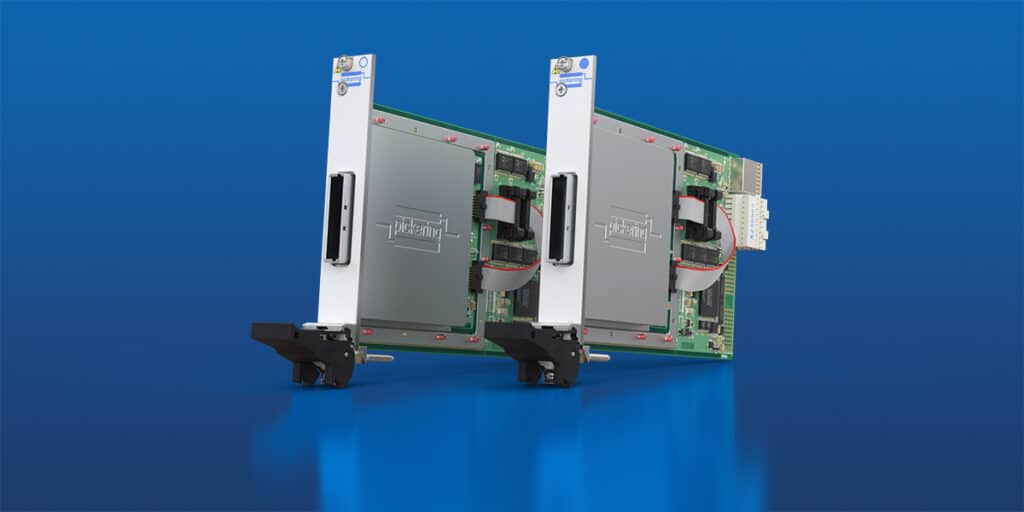
In a major leap for high-speed Ethernet testing, Pickering Interfaces has unveiled new MEMS-based fault insertion units (FIUs) are redefining bandwidth and reliability standards for PXI and PXIe systems. Designed to meet the rigorous demands of MultiGBASE-T1 networks, these modules deliver rapid fault simulation and exceptional durability—key factors in validating today’s advanced automotive and industrial communication systems.
Built around micro-electro-mechanical system (MEMS) switches, the new single-slot FIUs provide the highest bandwidth in their class. They enable precise simulation of connectivity faults in high-speed communication protocols, supporting the latest 10GBASE-T1 Ethernet requirements. Where conventional reed relays or electromechanical relays fall short, MEMS switches bring 50-µs switching speeds and operational lifetimes exceeding 3 billion cycles—dramatically improving test throughput and reducing maintenance downtime.
The key features are:
- Offers 4 or 8 channels of impedance-matched 2-wire signal paths.
- Supports Ethernet standards from 10BASE-T1 to 10 Gbps.
- Configurable for open-circuit, short pairs, or routing to external fault buses.
- Each fault bus can carry up to 1.6 A of current.
- Delivers low insertion loss and excellent VSWR for clean, consistent signals.
- Maintains stable RF characteristics beyond 6 GHz.
- Precision mechanical and electrical design minimizes noise and interference.
Targeted primarily at hardware-in-the-loop (HIL) simulation, the FIUs are optimized for validating the performance of automotive Ethernet systems such as ADAS controllers. As single-pair Ethernet expands beyond vehicles into aerospace and industrial networks, the modules offer engineers a futureproof solution for evolving test environments.
A versatile connector interface supports breakout accessories for multiple automotive Ethernet connector types, including Rosenberger H-MTD series. Optional rack-mount or shelf configurations enhance integration flexibility.For system reliability tracking, onboard relay-cycle counting allows engineers to monitor switching activity and rebalance heavily used paths to extend lifespan even further. With compact form factors, robust MEMS design, and compatibility across Ethernet generations, these FIUs significantly expand test system bandwidth, throughput, and longevity—delivering a decisive advantage in high-speed verification environments.
