




A new 100V MOSFET is targeting the toughest corner of modern power design48V hot-swap stages in AI servers by combining unusually strong SOA robustness with low conduction loss in a compact 5×6mm footprint.
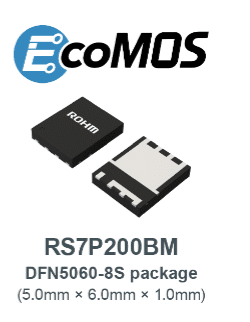
ROHM has introduced a new 100V MOSFET that aims squarely at the fast-growing 48V power architecture used in AI servers and industrial systems. The RS7P200BM, housed in a compact 5×6mm DFN5060-8S package, arrives with an unusually wide Safe Operating Area (SOA) for its sizepositioning it for hot-swap stages that must survive high inrush and overload events without sacrificing efficiency.
The launch comes as data-center hardware shifts toward higher-voltage distribution to curb power-conversion losses driven by GPU-rich AI clusters. Hot-swap MOSFETs in these systems face steeper electrical stress, and designers have been seeking parts that combine low on-resistance with strong transient robustness, two parameters that typically trade off against each other.
The key tech features include:
- Wide SOA for 48V hot-swap, sustaining high transient currents without compromising reliability.
- Low 4.0 mΩ RDS(on) to reduce conduction losses and improve system efficiency.
Compact 5×6mm DFN package enabling high-density layouts in space-constrained server boards. - Optimized for AI-class inrush events, balancing thermal performance and overload tolerance.
- Suitable for 48V architectures spanning AI servers, data-center power shelves, industrial gear, and battery-based systems.
It delivers a 4.0 mΩ RDS(on) at 10V gate drive while holding its SOA at levels normally associated with larger packages. At 48V, the device sustains 7.5A for 10ms and 25A for 1ms, providing designers wider margin when managing inrush or protecting downstream loads. The combination helps cut heat generation in power stages, which in turn reduces cooling overhead and improves system-level energy efficiency, an increasingly scrutinized metric in AI server deployments.
The RS7P200BM is also part of a broader 100V MOSFET expansion for 48V hot-swap circuits. It slots below ROHM’s earlier RY7P250BM (8×8mm DFN8080-8S), enabling higher power-density layouts where board real estate is tight. With more AI server makers migrating to compact, high-efficiency power modules, the availability of a smaller wide-SOA option gives engineers new flexibility in scaling their designs.


