What happens when automotive safety circuits face sudden high-current loads? A MOSFET design can suppress secondary breakdown and could provide reliability.
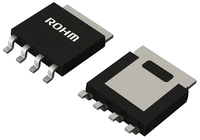
ROHM has developed a 100V MOSFET designed for automotive safety functions and protection circuits that can experience short-duration high-current and high-voltage loads.
The RS4P063BPHZG uses a design that suppresses secondary breakdown, achieving a Wide-SOA (Safe Operating Area) across a broad voltage range. According to ROHM’s September 2026 study, the device provides approximately five times the SOA tolerance of standard equivalent-sized products at a drain-source voltage (VDS) of 100V and a pulse width (PW) of 100µs.
SOA defines the voltage and current conditions under which a device can operate reliably without failure. Secondary breakdown occurs when current becomes concentrated in localised areas of a device under high voltage, potentially causing permanent damage. Suppressing this effect can improve a MOSFET’s tolerance to short-duration, high-power pulses.
The MOSFET is aimed at applications where power devices need to withstand short-duration electrical stress, including airbag inflator ignition circuits, seatbelt pretensioner drive circuits, pyro-fuse drives for battery cutoff, and other automotive protection functions.
The device is built in the HPLF5060 5060-size package, which is already used in automotive applications. This allows manufacturers to evaluate it against existing layouts without major package-level changes.
ROHM began mass production of the device in June 2026. The company is also developing Wide-SOA MOSFETs for automotive applications in larger HPLF8080 and TOLG packages.
For the official announcement, click here.