




Reducing current to nanoamp levels could extend battery life in compact devices, where even small power savings translate into longer operation.
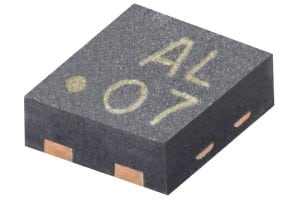
Murata Manufacturing has launched its MRMS166R and MRMS168R anisotropic magnetoresistance sensors, designed for healthcare, wearable, and IoT applications where power efficiency is a primary constraint. The MRMS166R, in particular, operates at an average current consumption of just 20 nA and supports a minimum supply voltage of 1.2 V, positioning it for coin cell powered systems.
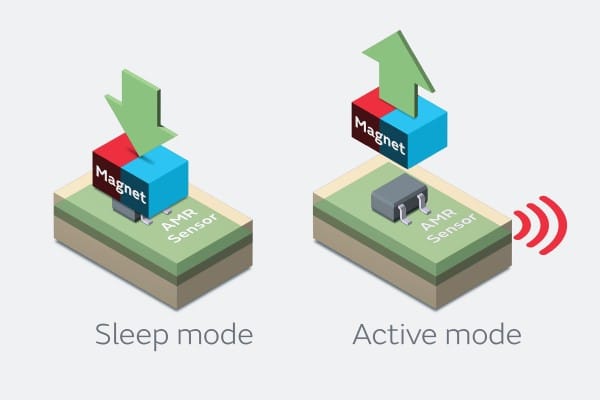
The sensors function as solid state magnetic switches, detecting the presence or absence of a magnetic field and translating it into control signals. This enables contactless switching in compact devices, eliminating mechanical wear and supporting sealed designs often required in medical and wearable form factors.
The sensor has an ultra low current consumption that directly impacts battery life. Devices that rely on standby modes, such as medical patches, capsule endoscopes, or wireless earbuds, can extend operational duration significantly when switching functions consume negligible power. Murata indicates that typical use cases can exceed two years of operation on small batteries.
The sensor also addresses a key limitation in low voltage systems. While many compact devices operate on silver oxide coin batteries with limited capacity and voltage margins, the sensors maintain stable performance even at reduced voltage levels by redesigning internal circuitry, enabling consistent operation without increasing energy demand.
The MRMS166R supports a 1.2 to 3.6 V range with minimal current draw, while the MRMS168R operates from 2.0 to 3.6 V and offers higher output current for load intensive applications. Both are housed in a compact 1.0 × 1.0 × 0.4 mm package, making them suitable for space constrained designs.
The development reflects ongoing efforts to reduce power consumption at the component level, supporting longer lasting and more compact electronic systems across healthcare, wearables, and connected devices.
Click here for the official announcement.


