Lithium ions can move through nanotube channels far faster than expected, exposing an unusual gap between theory and real nanoscale transport behaviour. How?
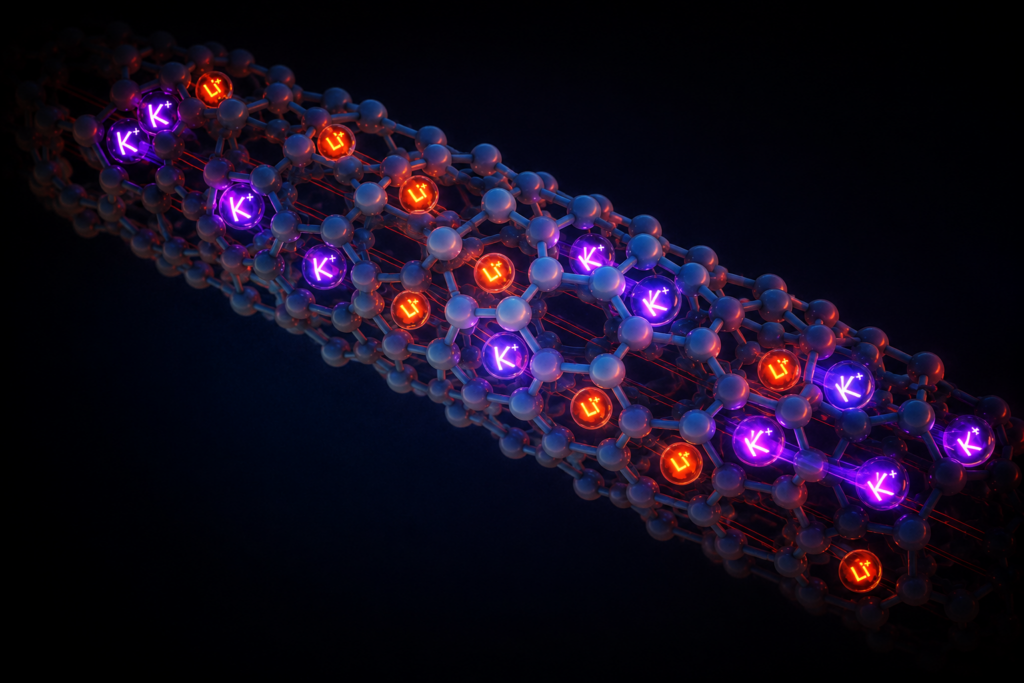
An artistic rendering of a boron nitride nanotube developed by UIC researchers and their collaborators in a new study.
Researchers at the University of Illinois Chicago have developed boron nitride nanotube based membranes that enable ultrafast and highly selective ion transport. The team explored how boron nitride nanotubes behave when assembled into dense membranes that allow ions to pass through controlled pathways.
Ion transport plays a central role in technologies such as batteries, desalination, and resource recovery. However, conventional membranes often face a trade off between speed and selectivity, limiting efficiency in industrial systems. Sluggish ion movement also increases energy costs in processes like lithium extraction and water purification.
The new membrane architecture addresses this limitation by using millions of boron nitride nanotubes as aligned transport channels. These nanotubes exhibit unusual surface charge behavior that influences ion motion. When exposed to solutions with different salinity levels, the membranes showed ion transport rates far beyond theoretical predictions.
Lithium ions in particular moved through the channels at rates reported to be about 31 times faster than expected. The system also demonstrated strong selectivity, allowing lithium ions to travel more efficiently than competing ions, which is critical for battery material recovery and chemical separation processes.
Beyond separation efficiency, the researchers showed that ion movement through the membranes could generate usable electrical output from salt concentration differences. Simple devices such as a watch and calculator were powered using this principle, demonstrating the potential of so called blue energy systems.
Applications could extend to lithium recovery from spent batteries, energy generation from salinity gradients, desalination systems, and next generation separation technologies where precise ion control is essential.
The team is now investigating the underlying mechanism responsible for the unusually high transport speeds, as well as scaling the system for practical industrial use. As Sangil Kim, associate professor of chemical engineering at UIC and an author of the paper, notes, “The ion transport is much higher than the theoretical estimation and also existing experimental systems.”