




Researchers have developed a fault-tolerant method that enables analog in-memory computing systems to operate accurately despite hardware defects, improving energy efficiency and reliability.
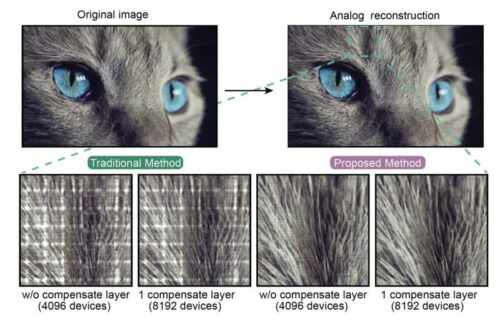
Researchers from the University of Hong Kong and Hewlett Packard Labs have developed a mathematical method that allows analog in-memory computing systems to continue performing accurate calculations even when parts of their hardware are defective. The approach could accelerate the development of faster and more energy-efficient computing technologies.
Conventional computers separate memory and processing, requiring data to move constantly between the two components. This transfer consumes considerable energy. In contrast, analog in-memory computing performs calculations directly where data are stored, significantly reducing power consumption and improving processing speed. These systems often rely on memristors, electronic devices that store information as continuously varying electrical states.
However, analog hardware is vulnerable to manufacturing imperfections, faulty devices and variations in component behaviour, which can reduce computational accuracy. Instead of attempting to eliminate these defects through costly manufacturing improvements, the researchers designed a mathematical framework that adapts computations to the imperfections already present in the hardware.
The new method decomposes a target computation into adjustable mathematical components, allowing faulty devices to remain in use while ensuring the final result remains accurate. Because the framework is independent of specific machine-learning models, it can be applied to a broad range of mathematical operations without retraining algorithms or modifying original datasets.
Experimental tests demonstrated the method’s effectiveness. In memristor-based evaluations, the approach achieved more than 99.999% cosine similarity for discrete Fourier transform operations even when 39% of the devices were faulty, a failure rate at which conventional direct-mapping methods no longer function correctly. The researchers also reported an energy-efficiency improvement of more than 164%.
The team further validated the approach using a prototype analog wireless communication system, where it reduced bit error rates by a factor of 56, achieving accuracy comparable to digital wireless systems. The researchers believe the method could lower manufacturing costs by making partially defective chips usable while advancing future analog, photonic and quantum computing technologies.

