




A new suite of open tools is poised to accelerate development of safer, more human-like autonomous vehicles by combining reasoning AI with simulation and real-world driving data.
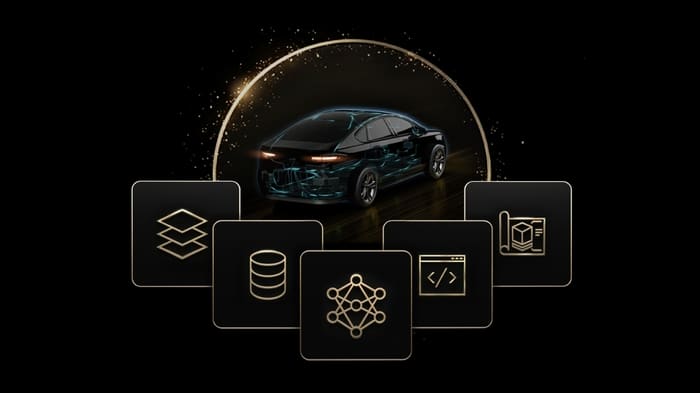
A major new open-source AI platform was revealed by NVIDIA that aims to tackle one of autonomous driving’s toughest problems: rare and complex road scenarios that current systems struggle to handle safely. The platform combines large reasoning models, high-fidelity simulation, and extensive datasets to give autonomous vehicle software a way to “think through” unusual situations rather than just react to sensors.
Traditional autonomous stacks often separate perception and planning, leaving gaps when vehicles encounter unusual events such as unexpected traffic light failures or unusual pedestrian behavior. The new approach introduces vision-language-action models with chain-of-thought reasoning ability, enabling AV systems to generate both planned paths and human-interpretable logic behind decisions. Developers can adapt these models as teachers into smaller, run-time capable versions suitable for actual vehicles.
The key features are:
- Reasoning-Powered Vision-Language-Action Models: Chain-of-thought AI that generates trajectories and explains decisions.
- Open-Source High-Fidelity Simulation: A testbed for closed-loop vehicle policy validation.
- 1,700+ Hours Driving Dataset: Extensive real-world data covering diverse and rare scenarios.
- Fine-Tuning and Distillation Support: Large teacher models can be adapted into smaller runtime variants.
- Transparency for Safety and Auditing: Outputs interpretable reasoning traces alongside actions.
Alongside the core reasoning model, the platform includes an open simulation toolkit designed to mirror real driving environments with realistic sensor inputs and traffic behaviors. This lets developers test and refine decision policies in closed-loop virtual streets before deployment. Complementing the simulator is a large open driving dataset, featuring more than 1,700 hours of footage from diverse geographies and conditions, including rare edge cases developers typically struggle to gather.
Industry players across mobility and research communities have expressed interest in leveraging the open ecosystem to accelerate their roadmaps toward higher levels of autonomy. By standardizing reasoning capabilities, simulation frameworks and data, the new platform aims to shorten development cycles and boost safety validation, while offering greater transparency into how AI-driven systems make choices on the road.

