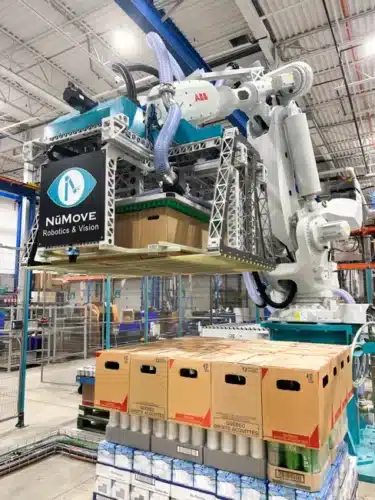
A robotic design that combines multiple gripping methods to reduce errors, provide speed and increase accuracy and fits your modern logistic needs.
As logistics operations grow more complex, warehouses get pressurized to process higher volumes while handling a wider mix of products. Traditional methods often struggle with mixed pallets, frequent Stock keeping Units changes, and unstable packaging. This creates a strong need for flexible, reliable automation that can adapt quickly without compromising speed or product safety.
NūMove Robotics and Vision has introduced a robotic tool designed to improve layer picking automation in high throughput logistics environments. The tool is built to efficiently depalletize both single SKUs and mixed or rainbow pallets, helping warehouses handle growing product variety and faster operations.
This end of arm depalletizing tool marks a major improvement over earlier designs that relied only on suction and forks. The new model integrates three gripping methods suction, clamping, and bottom forks allowing the robot to handle a wide range of packaging formats with greater reliability. These include closed and open cases, wrapped and unwrapped trays, and carton boxes placed in trays. To prevent product damage, sensors integrated verify that the layer is properly lifted before the bottom forks extend.
By combining three gripping mechanisms, the tool ensures stable operation even during fast robot movements. Each system supports a specific handling requirement.
Key features of this tool include
- Suction for picking partial layers and uneven arrangements
- Clamping for securely handling trayed products
- Bottom forks for support and reduced risk of losses
- Supported layer dimensions from 30 inches by 36 inches to 44 inches by 52 inches
- Layer heights from 2 inches to 20 inches
- Maximum payload of up to 600 pounds per layer
- Throughput of up to 3 layers per minute or nearly 2000 products per hour
The tool can be paired with a vision system that allows it to locate each layer, even if products shift during handling. As part of the company’s approach, additional equipment such as downstream conveyors can be added to ensure products exit the cell in a single file and short side leading which leads to flexibility, high performance automation for modern logistics operations.