A packaging method helps photonic chips work in heat, cold, vacuum, and radiation, enabling use in space, quantum systems, and industrial environments.
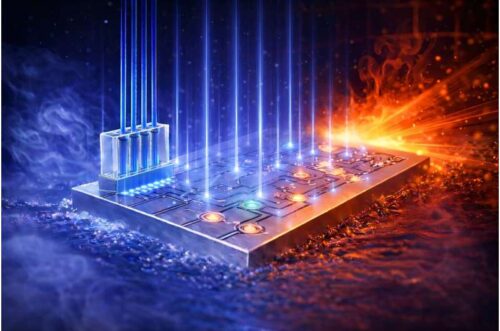
A new packaging method now allows photonic chips to operate in extreme environments such as high heat, radiation, vacuum, and very low temperatures. This work from the National Institute of Standards and Technology shows a path to using light-based chips in areas where conventional electronics fail. The study is published in Photonics Research.
Photonic integrated circuits use light instead of electricity to transmit data. They offer faster data transfer and lower power use. These chips are already used in telecom, sensing, and medical systems. However, their use in extreme environments has been limited due to packaging constraints.
Packaging connects the chip to optical fibers and electrical contacts while protecting it from damage. For photonic chips, this step is critical because even small misalignment can disrupt light transmission. Traditional packaging methods struggle to maintain stable connections under conditions like radiation, ultrahigh vacuum, or large temperature changes.
The main issue lies in attaching optical fibers to the chip. Common adhesives, such as polymer-based glues, degrade, crack, or release gases in harsh conditions. When this bond fails, the chip stops working.
To solve this, researchers used a method known as hydroxide catalysis bonding. This technique, originally developed for stable optical systems, creates a glass-like inorganic bond between the fiber and the chip. It uses a sodium hydroxide solution to form a molecular-level connection, removing the need for conventional adhesives.
The packaged chips were tested under cryogenic temperatures, rapid thermal cycling, high vacuum, and radiation exposure. The fiber connection remained stable, and the chip continued to function. Additional tests showed that the bonding approach can withstand temperatures beyond the limits of standard adhesives.
This method can enable photonic chips in systems that operate in extreme conditions. These include quantum computing setups, space systems, nuclear environments, and particle accelerators. It can also support industrial and energy applications where sensors must handle heat, pressure, and corrosive conditions.
The current process takes several days to complete, which may limit large-scale use. However, this is an engineering constraint that can be improved with further development.