




A method reduces the number of qubits needed for quantum computers, making practical machines possible sooner and affecting computing and digital security.
Scientists at the California Institute of Technology and the startup Oratomic have developed a method to drastically reduce the number of qubits needed for reliable quantum computing, potentially bringing practical machines closer. According to their findings, a fully functional quantum computer could operate with just 10,000 to 20,000 qubits, far below the millions previously thought necessary.
The breakthrough relies on a new quantum error-correction architecture that minimizes the number of redundant qubits required to fix errors, one of the biggest challenges in building stable quantum systems. Traditional approaches often need about 1,000 physical qubits to form a single logical qubit, making large-scale quantum machines extremely difficult to construct.
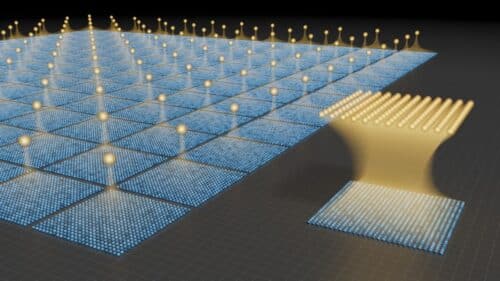
The method uses neutral atom systems, where individual atoms serve as qubits and are arranged with laser beams called optical tweezers. These atoms can be moved and connected over long distances, unlike qubits in other platforms. This flexibility enables high-rate error-correction codes, allowing each physical qubit to support multiple logical qubits. With this design, a single logical qubit could be formed from as few as five physical qubits.
The approach builds on advances in neutral atom arrays, with laboratory demonstrations already showing systems of more than 6,000 qubits. Long-range connections between qubits allow a single physical qubit to contribute to multiple logical qubits, improving efficiency and reducing hardware requirements compared with conventional architectures that limit interactions to nearest neighbors.
The implications extend to digital security. More efficient quantum computers could break widely used encryption methods, such as RSA and elliptic curve cryptography, much sooner than expected. They could also execute algorithms that factor large numbers exponentially faster than classical computers.
While the results remain theoretical, the progress in neutral atom systems suggests that practical, large-scale quantum computers may arrive sooner than previously anticipated, potentially reshaping computing and cybersecurity landscapes.

