Researchers at Tohoku University have built the world’s first spintronic probabilistic bit on a silicon chip, marking a significant step toward energy-efficient AI hardware and large-scale probabilistic computing systems.
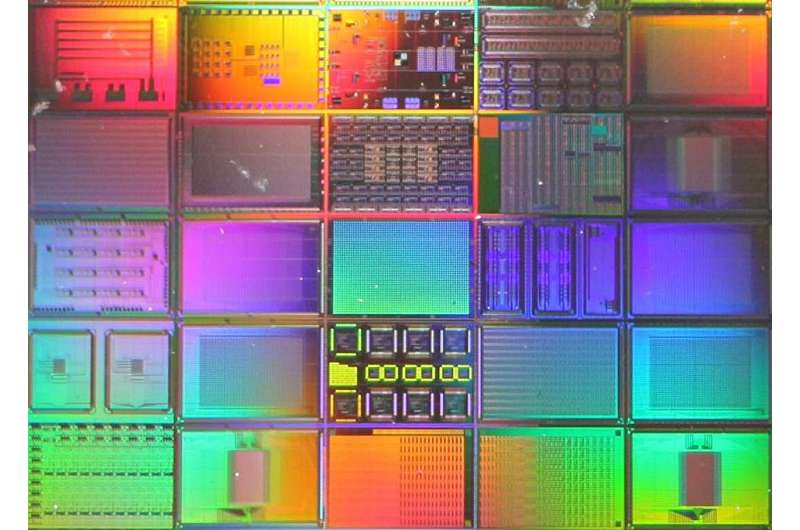
A Japan–US research team has demonstrated the world’s first spintronic probabilistic bit (p-bit) integrated directly onto a silicon chip using conventional semiconductor manufacturing processes. The achievement could accelerate the development of a new class of AI-focused computing systems designed to solve complex optimisation and machine-learning tasks more efficiently than traditional processors.
The breakthrough addresses growing limitations in conventional computing architectures as artificial intelligence workloads become increasingly demanding. Traditional processors operate using deterministic binary bits that switch between 0 and 1. Probabilistic computing takes a different approach, relying on p-bits that continuously fluctuate between the two states, enabling hardware to explore multiple possible solutions simultaneously. This capability makes p-computers particularly attractive for optimisation, inference and decision-making applications.
Researchers from Tohoku University, the National Institute of Standards and Technology and collaborators fabricated the devices by combining silicon CMOS manufacturing with spintronic components based on magnetic behaviour. The chips were produced using a 130-nanometer CMOS process before being integrated with nanoscale magnetic devices capable of generating intrinsic randomness.
Experimental testing confirmed two key characteristics required for practical p-bit operation. The devices exhibited stochastic fluctuations in output over time while also allowing researchers to control the average output state via applied input voltages. These capabilities are essential for building larger probabilistic computing networks capable of performing useful computational tasks.
Spintronics has long been viewed as a promising foundation for probabilistic computing because magnetic devices naturally produce random behaviour while consuming relatively little energy. Previous demonstrations largely focused on discrete components or laboratory-scale implementations. Integrating spintronic p-bits directly onto silicon using semiconductor manufacturing processes moves the technology closer to commercial scalability.
The researchers say the advance provides a pathway toward large-scale spintronic p-computers that could complement existing AI accelerators. As the semiconductor industry explores alternatives beyond conventional transistor scaling, probabilistic computing is emerging as a potential architecture for tackling computationally intensive workloads that are difficult to solve efficiently using today’s deterministic processors.