





A new method in trapping ions shows high accurate results in qubit stability and making it possible to produce in hours.
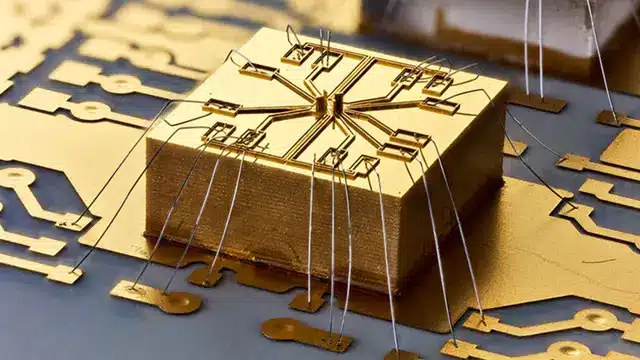
By trapping ions with 3D-printed miniaturised devices in quantum space, researchers reach up to 98% accurate results in a two-qubit quantum gate. The results show the 3D-printed traps can perform reliably as the other available ion trap systems, while being much faster to produce.
The traps are made with a high-resolution process called two-photon polymerisation. It prints in millimeter scale structures directly, thus reducing fabrication time to hours, reducing time drastically.
A complete trap prints in about 14 hours, while electrodes alone print in 30 minutes, enabling rapid testing of new geometrics, including hybrid planar-3D designs.
Trapped ions act as qubits when cooled with lasers. They can maintain quantum states for longer time than other qubit systems, and do not require cryogenic cooling systems. In previous approaches the trade-off is the flat-planer traps that scale easily, but will lose stability, and traditional 3D traps that are stable, but bulky and slow to manufacture.

Researchers from Lawrence Livermore National Laboratory (LLNL) and the University of California confirm that the traps hold Calcium ions at stable frequencies with lower error rates. They have demonstrated single-qubit rotations, ion swapping lasting for several minutes and entangling gates at 98% accuracy.
Printing combines these features, offering stability with flexibility and expanding the design space for future systems. Researchers plan to integrate electronics and photonics on chips and reduce noise from surrounding materials, which is a major source of error.
Beyond computing, printed traps can support precision tools such as atomic clocks, mass spectrometers and sensors. The findings are published in Nature.

