Can spintronics reduce computing energy demands? The material approach can enable precise spin control using minimal current, without external magnetic fields.
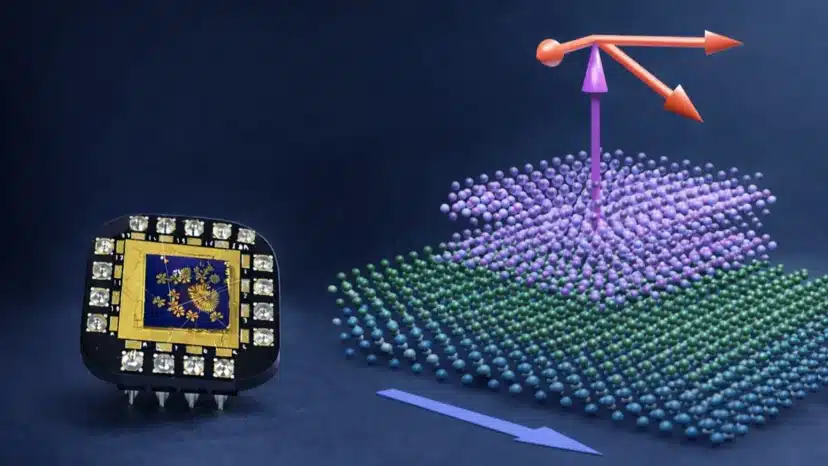
Researchers at Chalmers University of Technology have demonstrated a new approach to controlling electron spin, marking a step forward for spintronics and energy-efficient data processing. By combining different quantum materials into a layered structure, the team has achieved precise control over magnetic states using very small electrical currents, without the need for external magnetic fields.
The development addresses a long-standing challenge in spintronics, where controlling the magnetic orientation of electrons typically requires high energy input. Since spin-based systems rely on stable magnetic states rather than continuous charge flow, they offer the potential for faster processing with significantly lower power consumption. This makes them particularly relevant as data centres, AI systems, and cloud infrastructure continue to drive global energy demand.
The breakthrough is based on stacking atomically thin quantum materials in what are known as van der Waals heterostructures. By pairing a magnetic layer with a topological material, the researchers created new magnetic dynamics that allow spin states to be manipulated efficiently. The system also operates at room temperature, improving its potential for real-world applications in computing and memory technologies.
A key factor is the interface between the materials, which forms a nearly perfect, defect-free connection. This enables spin information to move between layers without degradation, maintaining signal integrity while allowing precise control. The researchers also highlight the role of structural asymmetry, where deliberately breaking symmetry within the material stack unlocks spin behaviors not possible in conventional systems.
Saroj Dash, lead author of a study, says, “The combination of these two quantum materials enables us to control electron spin using only very small electrical currents. It also works at room temperature, which means the method could eventually make data-processing and memory technologies both faster and more energy-efficient.”