




An open-source Raspberry Pi Pico detector counts muons from cosmic rays for under $100, bringing particle physics to the desktop.
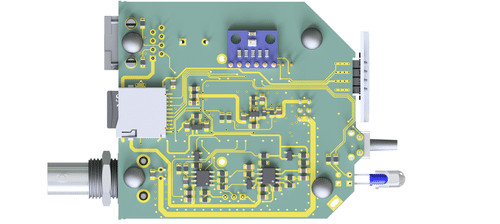
Cosmic rays constantly produce secondary particles, including muons, that pass through Earth and everything on it. CosmicWatch v3X, an open-source detector developed by researchers at the University of Delaware and MIT, can detect and log these muons, with each detection triggering a visible flash. The detector is designed to bring particle-physics measurements to a low-cost desktop platform.
The detector is built around a Raspberry Pi Pico and is designed for high-school and college students to assemble themselves. The team estimates the cost at under $100, although the final cost in India would vary with component prices, shipping and import charges.
CosmicWatch was started in 2017 by Spencer Axani while he was a graduate student at MIT. Axani is now an assistant professor of physics and astronomy at the University of Delaware.
The v3X is a self-contained, pocket-sized particle detector with an OLED that displays event counts, count rate, temperature, pressure and the current log file name. It records every detected event to a microSD card and can stream data over USB. Two units can also be connected with a network cable to form a “muon telescope”, helping reject most false detections.
The detector uses a Raspberry Pi Pico based on the RP2040, an onsemi MicroFC-60035 C-Series silicon photomultiplier (SiPM) with a 6 × 6 mm active area, and a 5 × 5 × 1 cm plastic scintillator made from polystyrene doped with PPO and POPOP. The build also requires dedicated main and SiPM PCBs, an OLED display, microSD storage, an RJ45 connector, temperature and pressure sensing, an enclosure and USB power. The repository provides Gerber files for the PCBs and enclosure design files. The SiPM and scintillator may require sourcing from specialist or international suppliers.
When a muon passes through the plastic scintillator, it produces a tiny flash of light. The SiPM, a highly sensitive light sensor capable of detecting individual photons, converts this flash into an electrical pulse. The Raspberry Pi Pico processes the pulse, records the event and measures its timing.
Muons are produced high in Earth’s atmosphere when cosmic rays collide with air molecules. They travel at speeds close to that of light, allowing some to reach the ground and be detected by a desktop-sized instrument.
PCB designs, firmware, GUI software, enclosure files and documentation are available in the CosmicWatch Desktop Muon Detector v3X GitHub repository. The project is licensed under Creative Commons Attribution-NonCommercial 4.0 (CC BY-NC 4.0), allowing users to build and modify the detector for personal or educational purposes, while commercial use is restricted.
According to the paper, a single detector at sea level records about 2.4 events per second (2.423 ± 0.005Hz). Two stacked detectors operating in coincidence record about 0.32 events per second (0.315 ± 0.002Hz), corresponding to about 0.76 muons per square centimetre per minute. The 2.3-microsecond coincidence window reduces accidental coincidences by about 100 times compared with the previous version.
Each detector consumes about 0.5W, while a 5,000mAh power bank can run two units for about 18 hours. The team has also flown the detectors to nearly 31 km on a high-altitude balloon and used them to study how muon counts vary with angle.
This is a soldering project rather than a plug-in kit, making it better suited to intermediate makers or school laboratories with teacher supervision. The plastic scintillator and SiPM may also be difficult to source in India. Its non-commercial licence restricts commercial kit sales without permission. The authors suggest experiments including measuring muon counts at different altitudes, testing shielding with materials such as concrete or lead, and studying how the count varies with the telescope’s angle.
India has a long history of cosmic-ray research, including the GRAPES-3 experiment at Ooty, which operates a large-scale muon telescope for studying cosmic rays. A CosmicWatch detector could allow college physics laboratories or Atal Tinkering Labs to demonstrate similar basic muon-counting measurements on a much smaller scale. The Raspberry Pi Pico and PCBs are relatively easy to source in India, while the SiPM and plastic scintillator may need to be imported. For institutions building several units, purchasing components in batches could help reduce the per-detector cost.
For Indian schools and colleges, CosmicWatch offers a practical way to take particle physics beyond the textbook and into hands-on measurement.
For more information, click here.


