




A receiver combines a light sensor and amplifier in one package, reducing parts and helping detect weak light signals in optical systems.
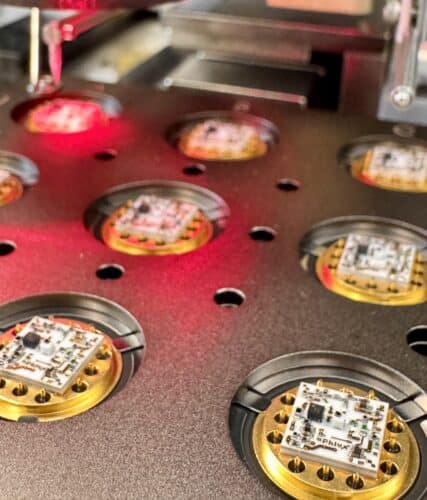
Phlux Technology has released beta samples of the Apex 200 µm receiver module (PX02200-TO), combining an InGaAs avalanche photodiode (APD) and a low-noise pre-amplifier in a standard TO-8, 12-pin package for ultra-low-light detection. By integrating the detector and amplifier into a single module, the receiver reduces the need for external signal-conditioning circuitry and simplifies optical receiver design.
Designed for applications that require detection of weak optical signals, the module operates across the 900–1700 nm wavelength range and is optimized for 1550 nm. It offers a bandwidth of 100 MHz, a noise equivalent power (NEP) of 35 fW/√Hz, a responsivity of 600 kV/W at 1550 nm, and an unloaded output voltage swing of 2.4 V with a 150 ns pulse.
The receiver includes an integrated temperature-sensing diode that compensates for changes in the APD’s high-voltage supply, helping maintain consistent responsivity across varying operating temperatures.
The Apex 200 µm module is intended for laser range finding, LiDAR, defence and security systems, distributed temperature sensing, gas sensing, analytical instruments, and other high-speed optical detection applications operating under low-light conditions.
Phlux is also expanding the Apex receiver family with smaller APD variants. Alpha samples of an 80 µm receiver are expected later this year, targeting an NEP of 47 fW/√Hz with bandwidth above 200 MHz. A 30 µm version is also under development for applications such as linear photon counting and quantum sensing, along with additional higher-bandwidth receivers.
The receiver family is based on the company’s Noiseless InGaAs APD technology, which uses an antimony-alloy semiconductor structure to achieve internal gain exceeding 120. The APDs are designed to meet MIL-STD-883 requirements, qualified to Telcordia GR-468 standards, and are compatible with existing surface-mount and TO-packaged APD designs, allowing upgrades without significant system redesign.
Click here for the original announcement.

