




By regenerating camera signals without retiming, the device preserves latency while extending reach for high speed in vehicle imaging links.
As vehicles integrate more cameras for monitoring and driver assistance, maintaining signal quality over longer internal connections has become a growing challenge. High resolution image data must travel reliably across circuit boards, connectors, and cables, often under tight power and space constraints. Signal loss and latency can directly affect system performance, making physical layer conditioning increasingly important in automotive electronic design.
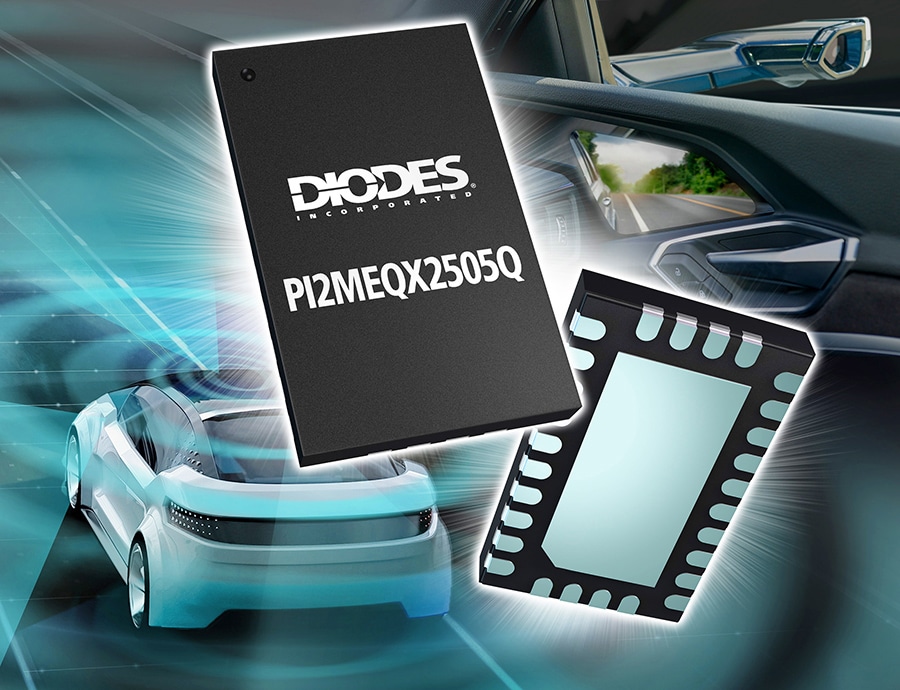
Diodes Incorporated has announced the release of the PI2MEQX2505Q, an automotive compliant MIPI D PHY ReDriver designed for camera monitoring systems and advanced driver assistance applications. The device targets in-vehicle image data links that require consistent electrical performance at higher data rates while meeting automotive qualification requirements.
The solution sits between a camera interface source and destination and restores weakened signals caused by trace length, connectors, or cabling. It supports multiple high speed data lanes along with a dedicated clock path and is designed to compensate for frequency related losses that occur as signals propagate through a system. By regenerating the signal rather than retiming it, the device helps preserve low latency while extending usable interconnect distance. Configurable equalization, voltage swing, and pre-emphasis settings allow designers to adapt the device to different board layouts and channel conditions, supporting higher pixel counts without excessive power draw.
Key features of the device include:
- Support for data rates up to 2.5Gbps
- Four differential data lanes and one clock lane
- Programmable receiver equalization levels
- Adjustable output voltage swing
- Selectable transmitter pre emphasis settings
- Low power operation with ultra low power and standby states
- Compact package for space constrained designs
Operating from a 1.8V supply, the device is designed with power efficiency in mind, particularly for battery electric vehicles. Integrated activity detection enables automatic transitions into lower power states when the link is idle, reducing overall system energy consumption.
By addressing signal integrity limitations in automotive camera links, the ReDriver supports more robust and scalable imaging architectures in modern vehicles, where reliability, efficiency, and compact design are increasingly critical.

