




What if robots could move and organize without code or electronics? These particles do this using shape and vibration to create coordinated behavior.
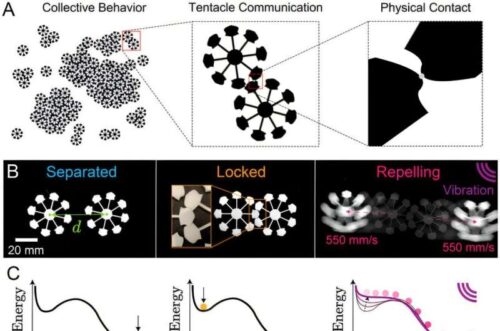
Researchers at Georgia Institute of Technology have developed robotic particles that can move, connect, and reorganize without using any electronics. There are no sensors, processors, or code involved. Their behavior is defined entirely by shape and physical interaction.
The system works through simple actions—bend, latch, and release. When exposed to vibration, the particles respond automatically. A single vibration can trigger a chain reaction, causing connected particles to detach and spread in sequence. No central control is required.
Each particle is identical and does not function on its own. It has flexible arms that bend and latch when particles meet, storing tension. When vibration is applied, this tension is released, and the particles separate. How long they stay connected and how quickly they release depends on design factors like curvature and stiffness.
This approach removes the need for complex hardware and software. Instead of adding processors or control systems, behavior is built directly into the structure. Changing the geometry changes how the system behaves.
The idea reflects earlier concepts of self-organizing machines, once imagined by Kurt Vonnegut. Here, that concept is demonstrated through physical systems where simple units form coordinated group behavior.
These particles can be made at different scales, from microscopic sizes to about 1.5 inches. At very small scales, they could move through blood vessels when activated by ultrasound, reaching areas that single devices cannot. This may support targeted drug delivery or mapping of complex biological pathways.
The same principle can extend to space applications. A compact group of particles could be deployed and activated remotely to spread, navigate obstacles, and reconfigure. Since they do not rely on electronics, they can operate in high radiation or extreme temperatures.
Ongoing work focuses on more advanced structures, where different vibration signals can trigger different responses. One signal may unlock a section, while another changes its configuration.

