




BrainChip’s AKD1500 accelerator boards start at $99 and bring event-based neural-network processing to Raspberry Pi 5 and PCIe-based systems, with the accelerator designed for low-power edge-AI operation below 300mW.
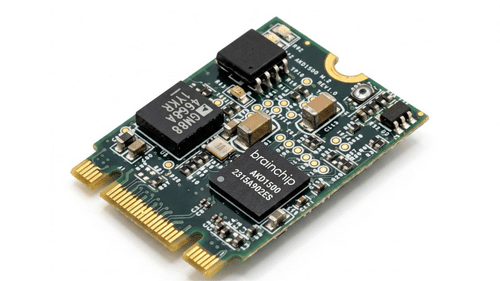
BrainChip’s AKD1500 is an edge-AI accelerator designed to run neural-network inference locally rather than relying on a cloud service. The device is available in multiple form factors, including M.2 and PCIe boards, allowing developers to connect the accelerator to systems ranging from a Raspberry Pi 5 to conventional computers.
The AKD1500 is based on a 22nm fully depleted silicon-on-insulator (FD-SOI) process. BrainChip specifies up to 800 giga-operations per second (GOPS) of processing performance and power consumption of about 250mW at a 400MHz operating frequency. The device includes 1MB of on-chip memory and supports clock frequencies from 5MHz to 400MHz. Supported neural-network models can be developed, converted and deployed using BrainChip’s Akida development environment and MetaTF tools.
For a Raspberry Pi 5 build, the M.2 version is the relevant option. The AKD1500 M.2 module can be connected through a compatible Raspberry Pi M.2 interface, while the PCIe development card targets systems with an appropriate PCIe slot. BrainChip also offers the BrainBoard 1500, which uses an SPI/QSPI interface for embedded hosts.
The hardware required for the Raspberry Pi implementation includes an AKD1500 M.2 module, Raspberry Pi 5, Raspberry Pi M.2 HAT+, suitable USB-C power supply, storage running 64-bit Raspberry Pi OS and active cooling. A Debian- or Ubuntu-based PC can instead be used with the PCIe version.
Unlike a conventional neural-network accelerator that performs the required operations for each input, an Akida-based spiking neural network (SNN) represents information as events and propagates activity when neurons change state. For suitable sparse workloads, this event-driven approach can reduce unnecessary computation and associated energy consumption.
The software workflow begins by setting up the Raspberry Pi 5 and confirming that the AKD1500 is detected over the PCIe/M.2 interface. BrainChip’s development resources can then be installed, including the required Akida runtime and supporting software. The device can be checked using the available hardware and software examples before deploying a model.
A practical starting point is one of the models provided through BrainChip’s model resources. Developers can load a supported model, connect an input such as a camera or microphone and run inference on the AKD1500 rather than the Raspberry Pi’s CPU. BrainChip’s Developer Hub also provides examples covering model preparation, conversion and hardware benchmarking.
Developers wanting to use their own networks can prepare supported models with the MetaTF development environment. The workflow can include training or fine-tuning a model, quantising it and converting it into a form that can be deployed on Akida hardware. Not every neural-network architecture is suitable for direct deployment, so model operators and network structure must remain within the capabilities of the Akida platform.
BrainChip’s Akida Engine provides the runtime layer for loading prepared models and performing inference on supported hardware. The public Developer Hub contains examples and benchmark workflows, including an AKD1500 Visual Wake Words example that demonstrates model preparation and hardware evaluation.
BrainChip specifies the AKD1500 at less than 300mW, with about 250mW cited at 400MHz. These are vendor specifications rather than measurements of a complete Raspberry Pi system. Actual frame rate and power consumption will depend on the selected model, input resolution, workload and host configuration. For a build article, accelerator power, host-system power and inference performance should therefore be measured separately.
The AKD1500’s 1MB of on-chip memory also places practical constraints on the models that can be mapped efficiently to the accelerator. The platform is intended for compact edge-AI workloads rather than large generative-AI models. Its event-based architecture is better suited to applications where low-power local inference is more important than running large general-purpose models.
Once inference is working, the classifier output can be connected to a physical action. A detected event could trigger a GPIO-controlled relay, indicator or external alert, turning the system into a closed-loop edge-AI device that senses, classifies and responds locally.
For Indian developers, the main attraction is the ability to experiment with low-power neuromorphic inference using a Raspberry Pi 5 rather than requiring a discrete GPU. The final cost, however, will depend on the AKD1500 variant, shipping, exchange rate, customs classification and import route. BrainChip’s M.2 option provides a compact route for Raspberry Pi-based development, while the PCIe card offers a path for desktop and embedded Linux systems.
For more information, click here.


