




A laser diode delivers record power from a 1 cm device, paving the way for smaller, more efficient laser systems for factories and research.
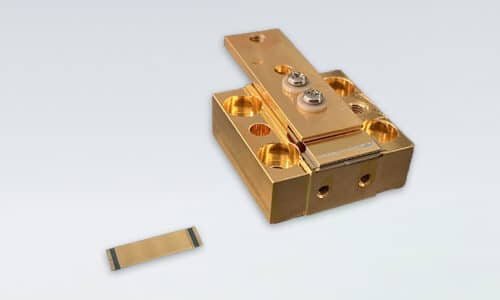
Hamamatsu Photonics has developed a 1 cm-wide laser diode (LD) bar that delivers a quasi-continuous wave (QCW) output of 2.0 kW at room temperature, using its proprietary high-power LD technology and new manufacturing processes. The company says this is a world-record output for a single-junction LD bar under these operating conditions.
The breakthrough is expected to support the development of more compact and energy-efficient high-power laser systems for industrial laser processing. It could also improve pump sources for solid-state lasers and enable new applications in fields that require high-energy light sources, including advanced manufacturing, space, and scientific research.
An LD bar consists of multiple laser diode emitters arranged in an array. These devices, along with stacked LD bar configurations, are widely used in industrial laser systems. Increasing the output of individual LD bars reduces the number of components needed in high-power laser systems.
To achieve the 2.0 kW output, Hamamatsu optimized the crystal structure, device design, crystal growth process, and assembly technology. The company also improved facet treatment technology to reduce degradation at the laser diode facets. The LD bar operates at a wavelength of about 940 nm in quasi-continuous wave mode, using 200 μs pulses at 10 Hz, with cooling water maintained at 18°C.
The LD bar used for the demonstration has a width of 1 cm and a single-junction structure, in which a single semiconductor PN junction serves as the active light-emitting region. It operates at a wavelength of approximately 940 nm in QCW mode using 200 μs pulses at 10 Hz. The measurements were carried out with cooling water maintained at 18°C, corresponding to room-temperature operation.
According to the company, the result surpasses the previous reported record of 1.9 kW achieved by a German research institute in 2022. Hamamatsu now plans to develop multi-junction LD bars, which stack multiple semiconductor PN junctions to achieve even higher optical output.

