




Researchers developed multistable knitted fabrics that snap between stable states, enabling wearable switches, sensors and interactive textiles for healthcare, robotics and smart clothing.
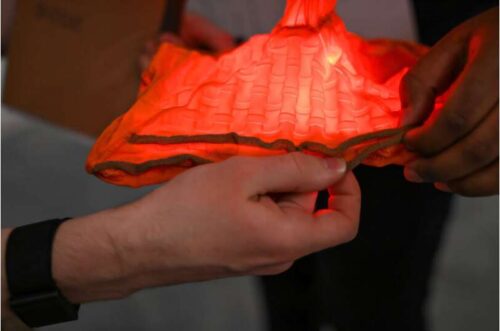
Researchers at Harvard John A. Paulson School of Engineering and Applied Sciences (SEAS) have developed programmable knitted fabrics that change shape between multiple stable configurations, opening new possibilities for smart textiles. The research, published in Advanced Functional Materials, demonstrates how ordinary knitting techniques can produce fabrics that function as switches, sensors and interactive devices.
The team engineered machine-knitted textiles that exhibit multistability, allowing them to snap between different shapes without continuous external force. By carefully selecting elastic yarns and adjusting knitting parameters, the researchers created dense fabrics capable of naturally curling into three-dimensional structures while maintaining stable configurations.
To understand the behaviour of the materials, the researchers combined horizontal and vertical stripe patterns to control the snap-through response. They also developed computational models that accurately predicted how the knitted textiles would perform, treating the fabric as a continuous material rather than tracking individual yarns. This approach helped identify the physical conditions required for stable and repeatable switching.
The concept was demonstrated through several functional prototypes. These included a wearable textile switch that detects movement around the knee or elbow and sends signals to an Arduino to count steps, a reconfigurable lampshade with multiple switches controlling different LED colours, and a shell-shaped knitted structure that switches an LED on and off as it changes state. Conductive yarns embedded within the fabric enabled the textiles to act as flexible electrical switches while remaining soft and stretchable.
Because the manufacturing process relies on conventional industrial knitting machines, the technology has strong potential for large-scale production. The researchers believe the approach could support next-generation wearable electronics, responsive garments, soft robotics, healthcare monitoring systems and adaptive textiles capable of sensing movement, providing tactile feedback and changing shape on demand.

