Smartwatch AI signals a new era where unseen sensing hints at effortless control, transforming how humans interact with devices.
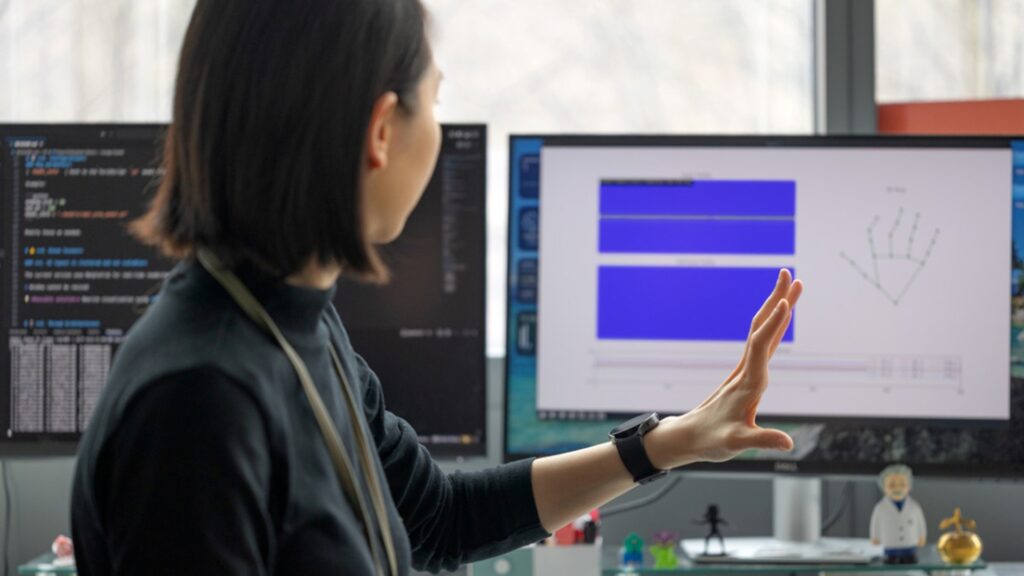
A new breakthrough in wearable technology is transforming how humans may interact with digital devices, using nothing more than a standard smartwatch. Researchers from Cornell University and KAIST have developed a system called WatchHand that enables real-time 3D hand tracking through AI-powered sonar.
The innovation leverages components already built into most smartwatches, the speaker and microphone. By emitting inaudible sound waves and analyzing the echoes that bounce back from the user’s hand, the system creates a detailed acoustic profile. A machine learning algorithm then processes this data directly on the device to estimate the position and movement of fingers and wrists in three dimensions.
Unlike conventional hand-tracking technologies that depend on cameras or external sensors, this approach requires no additional hardware. This makes it far more practical for widespread adoption, as it could potentially be deployed across millions of existing smartwatches through software updates alone.
The researchers envision a future where the human hand itself becomes a primary input tool. Tasks such as typing, navigating interfaces, or controlling digital environments could be performed through simple gestures, reducing dependence on keyboards, touchscreens, or mice. Early testing involved 40 participants across multiple studies, generating extensive gesture data under varying conditions, including different watch models and noisy environments.
Results showed that the system can reliably track hand and wrist movements with notable accuracy. Potential applications extend to augmented and virtual reality, gesture-based computing, and assistive technologies for individuals with limited mobility or speech.
Another key advantage is privacy. Since all processing occurs directly on the smartwatch, sensitive motion data does not need to be sent to external servers. This also reduces latency, enabling faster, real-time responses.
While promising, the system currently works best on Android-based devices and faces challenges when users are in motion. Researchers are continuing to refine its performance. Overall, this development highlights how software-driven innovation can unlock powerful new capabilities in everyday wearable devices.