A robot that moves without motors, folding like origami and powered by heat, hints at a new way to design machines that work without external systems.
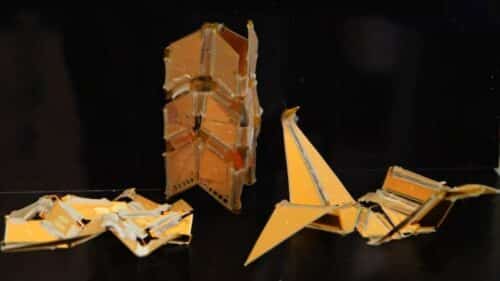
Engineers at Princeton University have built a soft–rigid hybrid robot that moves without motors or external pneumatic systems. The design uses a liquid crystal elastomer, embedded electronics, and origami-based structures to create motion through controlled heating.
The work shows a 3D-printed robot that can repeatedly move and return to its original shape without visible wear. In one example, an origami crane flaps its wings when electricity is applied. The motion comes from heating specific regions of the polymer, not from mechanical parts.
The system is built by printing a liquid crystal elastomer in patterned regions. Each region has a defined molecular alignment, set during printing. These regions act as hinges that bend in programmed ways when heated. By arranging and stacking them, the structure can fold and unfold in a controlled sequence.
Flexible printed circuit boards are embedded directly into these hinges during printing. This allows the system to heat selected areas and monitor temperature using built-in sensors. The heating causes the material to contract, which drives folding at specific points. Fiberglass sections are added between hinges to limit movement to defined regions.
The motion is based on origami models that define how the structure folds and unfolds. The control system uses feedback from temperature sensors to adjust for small errors during repeated cycles. This helps maintain consistent movement over time.
The project started as an undergraduate effort to create repeatable units that can change shape. The approach combines material design, embedded electronics, and structural geometry into one system. A software tool was also developed to help design similar robots by defining folding patterns and control sequences.
Researchers reported that the main challenge was integrating multiple technologies into a single platform. The result is a system that shows how soft robots can move and operate without relying on traditional actuators or external hardware.