




A chip-based lidar design could eliminate moving parts while delivering wider scanning for the next generation of autonomous machines.
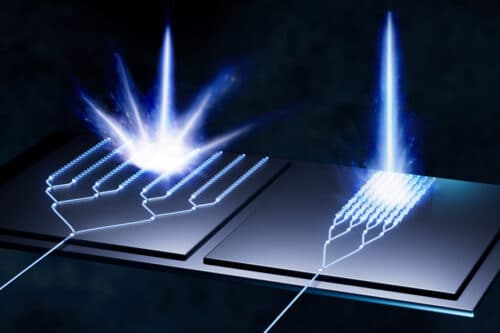
MIT researchers have developed a silicon-photonics lidar chip designed to improve autonomous sensing systems by removing the moving parts used in conventional lidar devices. The chip achieves a wider field of view while maintaining accuracy, addressing a limitation in existing solid-state lidar systems.
Traditional lidar systems use spinning assemblies that emit pulses of infrared light in multiple directions to map surrounding environments. These systems are often expensive, large, and subject to wear because they depend on mechanical motion.
Silicon-photonics lidar systems provide an alternative by steering light electronically through an integrated optical phased array (OPA). In these systems, light is routed through arrays of antennas embedded on a photonic chip. By adjusting the phase of light sent to each antenna, the beam can be directed in different directions without mechanical movement.
Existing silicon-photonics lidar systems face a tradeoff. Antennas must be placed close together to achieve a wide field of view, but closely packed antennas interfere with one another through electromagnetic coupling. This crosstalk distorts the beam and reduces accuracy. Engineers often place antennas farther apart to reduce coupling, but that creates grating lobes, or duplicate beams appearing at different angles. These extra beams reduce efficiency and can create false detections.
To address the problem, the MIT team redesigned the antenna array. Instead of using identical antennas, the researchers created three antenna geometries with different widths and corrugation patterns. These changes altered how light propagated through each antenna, giving neighboring antennas different propagation coefficients.
Because adjacent antennas behaved differently, they could be positioned closer together without interacting strongly. At the same time, each antenna still had to emit the same amount of light, direct beams at the same angle for a given wavelength, and steer uniformly across the array.
The researchers developed electromagnetic theory describing how radiative modes couple inside the array and used it to design, simulate, fabricate, and test the system.
Tests showed the design reduced antenna coupling from nearly 100 percent in conventional OPAs to roughly 1 percent while maintaining a single beam and wide-angle steering without generating grating lobes.
The technology could support lidar systems used in autonomous vehicles, robotics, aerial mapping, and construction monitoring.


