The sound waves move light in small spaces. The change can help make thin screens, fast data tools, and better VR and hologram devices.
Researchers from Stanford University have created a tiny device that uses high frequency sound waves to control light at the nanometer scale. This breakthrough could lead to thinner displays, faster optical data transfer, and better holographic VR headsets.
The compact system works by confining light in a gap just a few nanometers wide between gold nanoparticles and a gold mirror. Sound waves, vibrating nearly a billion times per second, pass through a soft polymer layer beneath the particles. These waves cause the nanoparticles to shift up and down, changing the gap size and in turn the color and brightness of the light.
This mechanical method lets researchers tune light precisely using sound, something earlier systems struggled to do at such a small scale. Even tiny movements just a few atoms wide produced major shifts in how light scattered.
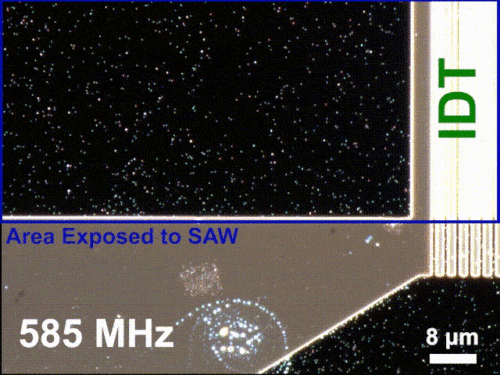
The result is a striking effect. When white light is shined from the side, the nanoparticles flicker like colorful stars against a dark background. The mirror reflects away light that does not interact with the particles, so only scattered light reaches the viewer.

While the idea of using sound to control light is not new, earlier devices had to be large to work well. Sound waves move far more slowly than light, and their physical motion is very small, around 1000 times smaller than a light wave. The new design solves this by shrinking the entire system and using a thin, stretchable polymer layer only 2 to 10 nanometers thick.
The setup includes a grid of gold nanoparticles, each about 100 nanometers wide, placed on the soft layer. An interdigitated transducer at one edge sends surface acoustic waves through the gold mirror. These waves deform the soft layer and shift the nanoparticles just enough to compress or expand the nanoscale light gaps.
Because the device is so small, energy efficient, and responsive, it opens new possibilities for technologies that depend on fast and precise light control, like future VR displays, 3D holograms, optical computing, and even neural networks based on light.