




The advancement combines high conductivity with extreme flexibility—stretching up to ten times its length—paving the way for next-gen wearables, soft robots, and motion-sensing fabrics.
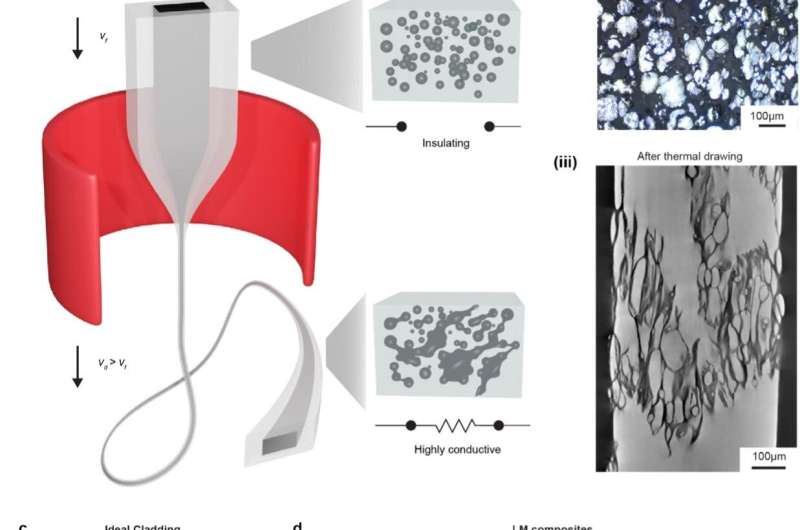
Researchers at École Polytechnique Fédérale de Lausanne (EPFL) have developed a novel “electronic fibre” embedded with droplets of a room-temperature liquid metal alloy, which remains reliably conductive even when stretched to more than ten times its original length.
The advancement centres on embedding a non-toxic indium-gallium liquid metal into a soft elastomer matrix, then using a thermal drawing process—typically used for fibre-optics—to pull a larger preform into long, thin fibres. As the fibre is drawn and the material stretches, the liquid metal breaks into fine droplets and activates specific conductive pathways, giving the team fine control over which regions of the fibre conduct and which don’t.
In testing, the fibre maintained high sensitivity even when extended to over 10× its original length—behaviours that many existing stretchable electronics struggle to achieve because of trade-offs between conductivity, stretchability and durability. As a proof-of-concept, the team integrated the fibre into a soft knee brace. The brace tracked knee bending, gait during running, squatting and jumping—and successfully reconstructed motion angles in real time.
The team explains that the work has a potential for scale and integration: conventional electronics tend to be rigid, fragile or bulky, limiting their use in wearables, soft robotics and textiles. By contrast, the new fibre can in principle be embedded into metres or even kilometres of fabric, offering a pathway toward smart garments, prostheses, robotic skins and motion-sensing textiles. Translation into commercial products will bring challenges: manufacturing at high volumes, ensuring long-term durability and integration into everyday textiles are non-trivial. But this research, published in Nature Electronics, shows a concrete step toward electronics that literally stretch with the user or machine.


