Cornell researchers develop microscale machines that synchronise their movements via electronic pulses, opening up new possibilities in various fields.
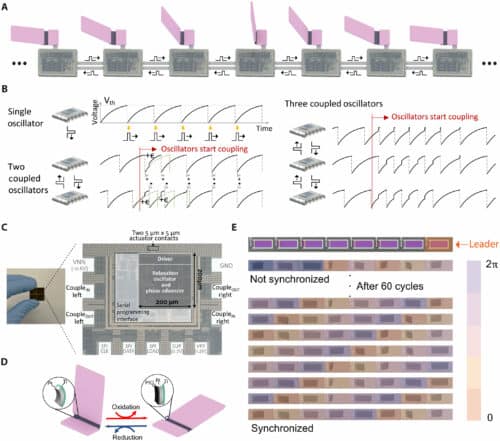
Cornell University (CU), USA researchers have made an advancement in micromachine technology. Their research demonstrates how microscopic robots can autonomously coordinate their actions by exchanging electronic pulses. This synchronisation showcases innovative uses in drug delivery, chemical mixing, and environmental cleanup.
The research, led by professors Alyssa Apsel and Itai Cohen, CU introduces a novel technique for synchronising microscale machines equipped with low-power, complementary metal-oxide-semiconductor (CMOS) oscillators. These oscillators send electronic pulses to neighbour machines, aligning their movements with the fastest oscillator in the system, without the need for central control. “The oscillators are very low power such as sub-nanowatt and operate with low complexity,” said Apsel.
This technology holds great potential for industries such as medicine, environmental science, and manufacturing. In the medical field, microrobots could be used for precise drug delivery systems, while in environmental science, they might be deployed for cleaning up pollutants. Industries involved in material science and robotics may also find applications for this synchronised system, advancing collaborative construction and fluidic transport processes at the microscale.
The method relies on a pulsed coupling technique that allows each machine to adjust its timing based on the pulses from its neighbours. This decentralised approach is inspired by natural phenomena, like fireflies flashing in unison or heart cells beating together. It enables the machines to synchronise cohesively, even in the face of disturbances. “This decentralised approach allows the system to self-correct and maintain synchronisation even when conditions change,” explained Milad Taghavi, one of the research’s co-authors and a PhD student in Apsel lab, CU.
Researchers successfully synchronised arrays of up to 16 micromachines in both linear and two-dimensional configurations. The technique has demonstrated scalability, which will allow for the coordination of larger, more complex networks of microrobots in future applications.
The work not only advances microrobot synchronisation but also opens doors to new fields of research, such as the development of electronic materials with emergent behaviours. “It paves the way to making electronic materials where electronics are incorporated at each material element to create emergent behaviours that cannot be achieved in natural systems,” said Cohen.
As the team looks ahead, they are exploring further applications of these micromachines, including models that could mimic inchworms or split into autonomous pieces. “This research shows that you can use ideas from biology and nature to demonstrate collective behaviours,” Apsel concluded.