




With high-resolution 3D point clouds and Doppler data, this vision sensor aims to close critical visibility gaps in autonomous driving.
Poor visibility remains one of the biggest challenges for advanced driver assistance and autonomous driving systems, particularly in rain, fog, snow and low light conditions. Conventional radar and lidar technologies often struggle to balance resolution, range, and reliability, leaving critical gaps in perception that can compromise safety on real roads.
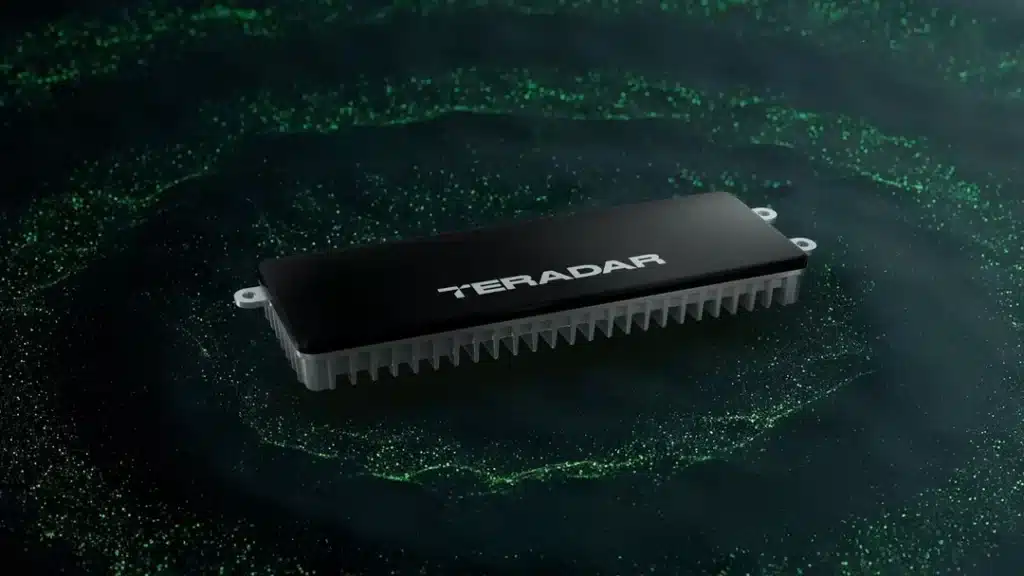
Teradar unveiled its flagship terahertz vision sensor, positioned as the industry’s first long range, high resolution THz solution designed for automotive use. The company says the system is built to enhance ADAS and support autonomous driving from Level 2 through Level 5, while operating consistently in all weather and lighting conditions.
Terahertz waves sit between radar and lidar on the electromagnetic spectrum, combining fine spatial resolution with the ability to penetrate fog, rain, snow and glare. Recent advances in chip design have enabled this sensing method to move from theory into practical deployment. The sensor is based on a fully solid state architecture that integrates proprietary transmit, receive and processing chips into a modular system.
The platform delivers a detection range of up to 300 meters, or 984 feet, with a native angular resolution of 0.13 degrees. It generates detailed three dimensional point clouds with Doppler information, capturing distance, direction, elevation and relative speed of objects, even at long range.
Key features of the sensor include:
- Solid state digital phased array design
- Long range detection up to 300 meters
- High resolution 0.13 degree sensing
- Three dimensional point clouds with Doppler data
- Reliable performance day or night and in adverse weather
According to the company, this technology bridges the gap left by traditional radar and lidar, enabling vehicles to maintain accurate perception when existing systems break down.
Matt Carey, Teradar’s CEO and co-founder says, “By delivering visibility through fog, rain, snow, and sun glare, we are opening a sensing domain that has not existed in automotive before,” adding that the goal is to give vehicles reliable vision in the conditions where today’s systems fail.


