How are x-rays telling us what is happening inside semiconductor chips while they are operating?
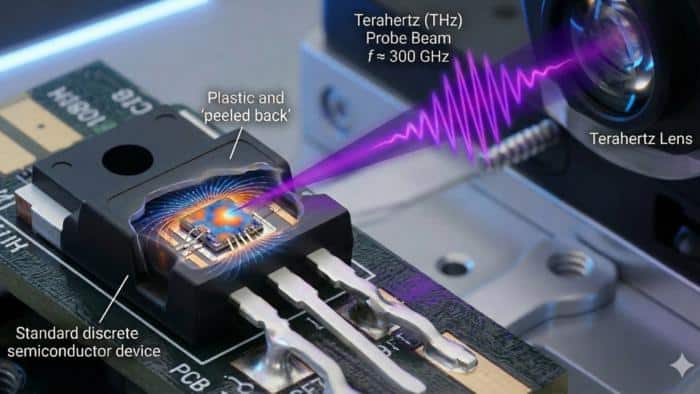
A team of international researchers has developed a ground-breaking technique to observe what happens inside electronic chips while they are actively operating. This innovation allows engineers to monitor semiconductor devices without physically touching them, dismantling their packaging, or switching them off. For the first time, electronic components can be studied in real-world conditions without interrupting their functionality.
The method relies on terahertz waves, a safe and non-ionising form of electromagnetic radiation, to detect extremely small movements of electrical charge within fully packaged chips. By using these waves, researchers can capture internal electrical activity from outside the device, overcoming a long-standing limitation in semiconductor analysis.
Overcoming previous issues
Semiconductors are fundamental to modern technology, powering everything from smartphones and medical equipment to vehicles, energy systems, and defence infrastructure. However, once a chip is sealed within its protective casing, understanding its internal behavior becomes extremely difficult. Traditional inspection techniques often require physical probes, exposed circuits, or powering down the device, making them impractical for many real-world applications.
This new approach addresses those challenges by enabling non-invasive detection of current changes in standard electronic components such as diodes and transistors. Remarkably, the system can identify variations in regions smaller than the wavelength of the terahertz signals used, surpassing previous assumptions about measurement limitations caused by noise.
Ultra-sensitive systems for small changes
To achieve high sensitivity, the researchers designed an advanced detection system incorporating a specialised homodyne quadrature receiver. This system minimizes background noise and isolates the weak signals generated by internal electrical activity. As a result, it provides a real-time view of chip operation, even when the active regions are deeply embedded within sealed packaging.
Beyond research applications, this technology holds significant potential for security and defence. It could enable remote verification of hardware integrity, detection of faulty or compromised components, and monitoring of critical systems where physical access is restricted. Ultimately, this breakthrough paves the way for smarter, self-diagnosing electronics, improved monitoring of complex integrated circuits, and faster development of next-generation semiconductor technologies.