




HomeElectronics NewsThe First Universal, Programmable And Multifunctional Photonic Chip

The First Universal, Programmable And Multifunctional Photonic Chip

The photonic chip enhances 5G, AI, and more, developed by researchers and already impacting telecommunications and tech industries.
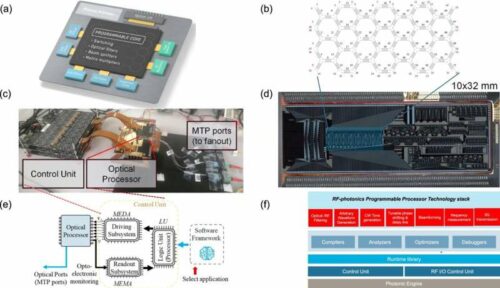
The photonic processor elements and layers. a Optical layer of the processor with the core, I/Os, and high-performance blocks, b schematic of the waveguide mesh core, c assembled chip with control unit and access fibers, d picture of the chip with the highlighted region of the reconfigurable core, e interconnection diagram between optical system, control unit and software layer, f Software layer stack employed in this work. Credit: Nature Communications (2024). DOI: 10.1038/s41467-024-45888-7
The photonic processor elements and layers. a Optical layer of the processor with the core, I/Os, and high-performance blocks, b schematic of the waveguide mesh core, c assembled chip with control unit and access fibers, d picture of the chip with the highlighted region of the reconfigurable core, e interconnection diagram between optical system, control unit and software layer, f Software layer stack employed in this work. Credit: Nature Communications (2024). DOI: 10.1038/s41467-024-45888-7

Researchers from the Photonics Research Laboratory (PRL)-iTEAM at the Universitat Politècnica de València, in collaboration with the company iPRONICS, have developed a groundbreaking photonic chip. This innovative chip is designed for use in telecommunications, data centers, and artificial intelligence computing infrastructures. It stands out as the world’s first universal, programmable, and multifunctional photonic chip.

- Advertisement -

This chip will enhance a wide range of technologies including 5G communications, data centers, quantum computing, artificial intelligence, satellites, drones, and autonomous vehicles, among various other applications.

The creation of this chip is the primary outcome of the European project UMWP-Chip, spearheaded by researcher José Capmany. The findings have been documented in the journal Nature Communications.

The chip developed by the UPV and iPRONICS team enables on-demand programming and interconnection of wireless and photonic segments within communication networks. This functionality helps prevent bottlenecks that can restrict both capacity and bandwidth.

- Advertisement -

The researchers explain that applications such as 5G or autonomous cars require higher frequencies, which necessitates reducing the size of antennas and associated circuits. The research team has successfully developed a converter, an interface chip behind the antenna, that is as small and compact as possible, ready to support both current and future frequency bands.

The chip has been successfully integrated into an iPRONICS product called Smartlight, and it has already undergone testing with Vodafone.
“For us, the development of this chip is a crucial step because it has allowed the validation of our developments applied to a growing problem, the efficient management of data flows in data centers and networks for artificial intelligence computing systems. Our next goal is to scale the chip to meet the needs of this market segment,” said Daniel Pérez-López, co-founder and CTO of iPronics.

Resources: Daniel Pérez-López et al, General-purpose programmable photonic processor for advanced radiofrequency applications, Nature Communications (2024). DOI: 10.1038/s41467-024-45888-7


Nidhi Agarwal is a journalist at EFY. She is an Electronics and Communication Engineer with over five years of academic experience. Her expertise lies in working with development boards and IoT cloud. She enjoys writing as it enables her to share her knowledge and insights related to electronics, with like-minded techies.


Nidhi Agarwal
Nidhi Agarwal
Nidhi Agarwal is a Senior Technology Journalist at Electronics For You, specialising in embedded systems, development boards, and IoT cloud solutions. With a Master’s degree in Signal Processing, she combines strong technical knowledge with hands-on industry experience to deliver clear, insightful, and application-focused content. Nidhi began her career in engineering roles, working as a Product Engineer at Makerdemy, where she gained practical exposure to IoT systems, development platforms, and real-world implementation challenges. She has also worked as an IoT intern and robotics developer, building a solid foundation in hardware-software integration and emerging technologies. Before transitioning fully into technology journalism, she spent several years in academia as an Assistant Professor and Lecturer, teaching electronics and related subjects. This background reflects in her writing, which is structured, easy to understand, and highly educational for both students and professionals. At Electronics For You, Nidhi covers a wide range of topics including embedded development, cloud-connected devices, and next-generation electronics platforms. Her work focuses on simplifying complex technologies while maintaining technical accuracy, helping engineers, developers, and learners stay updated in a rapidly evolving ecosystem.

SHARE YOUR THOUGHTS & COMMENTS

EFY Prime

Unique DIY Projects

Electronics News

Truly Innovative Electronics

Latest DIY Videos

Electronics Components

Electronics Jobs

Calculators For Electronics
