

Thermal constraining technique stabilizes ferroelectric transistors, boosting efficiency and endurance for next-gen electronics.
A team led by Professor Taesung Kim at Sungkyunkwan University has unveiled a semiconductor design technique that uses thermal forces to dramatically improve next-generation AI chip performance while trimming energy use a development that could help solve one of electronics’ toughest challenges: heat management.
AI accelerators and edge devices increasingly struggle with thermal limits as workloads grow more complex and dense. Traditional silicon-based designs rely on chemical dopants and complex processing to stabilize transistor materials, which can hurt scalability and efficiency. The new approach takes a different tack, harnessing thermal expansion and contraction to physically shape key materials during fabrication.
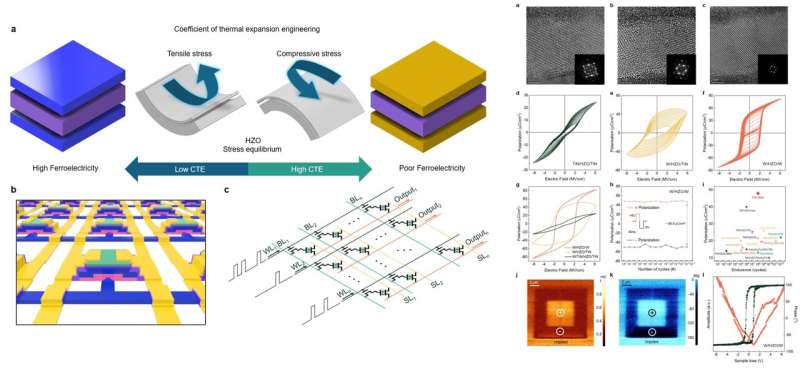
At the heart of the innovation are ferroelectric transistors made with hafnium oxide, a material prized for in-memory computing a paradigm that embeds computation within memory to slash data movement delays. Achieving the desired crystal alignment in ultra-thin hafnium oxide has been a longstanding hurdle: even slight misalignment undermines functionality. Instead of adding chemical elements to fix the structure (a process that adds complexity and cost), researchers engineered the surrounding electrodes so that cooling contraction applies compressive stress. That pressure naturally aligns the atoms into the optimal orthorhombic phase for memory function.
Chips produced with this “thermal constraining” method showed remarkable stability surviving more than a trillion switching cycles and delivered high accuracy (97.2 %) on AI image-recognition tasks with significantly lower energy use than comparable devices. Experts say the work tackles a central bottleneck for future electronics: managing heat without compromising performance. As AI models get bigger and chip power densities rise issues highlighted in broader industry discussions about thermal limits and power delivery in AI silicon physical design strategies like this could become vital.
If the technique scales to production, it may influence how processors for autonomous systems, mobile hardware, and edge AI are built potentially enabling smarter devices that stay cool under pressure without needing exotic cooling systems or power-hungry hardware.