A new 3D screen needs no glasses, is thin, and shows clear images. It could change learning, healthcare, and entertainment.
Glasses-free 3D displays have often had to compromise between thickness, resolution, and viewing angle, which has limited their use in areas like healthcare, education, and entertainment. Most existing systems are bulky, often over 500 mm thick, and struggle to show fine 3D details across wide angles. To solve these problems, researchers at Zhejiang University in China have created an ultra-thin 3D display that is only 28 mm thick while offering high resolution and a wide viewing angle.
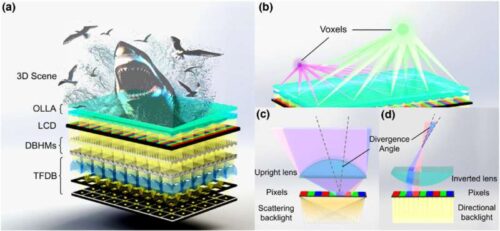
The display keeps images sharp across the entire depth, making it useful for tasks that need precise spatial understanding, like visualizing complex anatomical structures. The system uses a directional backlight to control light precisely. This allows each eye to see a slightly different image, creating natural 3D depth without glasses. Smaller, well-designed voxels, which are the 3D pixels forming the image, provide finer detail and more realistic depth. This approach produces much smaller voxels and higher resolution than traditional scattering backlight displays.
Freeform optics, with specially shaped surfaces that guide light, make the thin but large backlight system possible. Each beam channel includes an LED light, an aperture, and a freeform lens, giving uniform light in a precise direction. Many of these channels are combined to make a large backlight, and two layers of micro-triangular prisms improve uniformity without losing direction control.
Tests using a 50-mm fixed-focus lens showed the display can render images, such as an astronaut floating outside a space station, with a continuous depth of 1 meter and a viewing angle over 120 degrees, creating an immersive experience. Compared with traditional scattering backlight displays, this design produces voxels six times smaller, keeps resolution at longer distances, and uses visual information about 100 times more efficiently.

Researchers are now working to make the display even thinner and lighter, improve optical efficiency, and optimize pixel structures for higher density, aiming to bring this technology closer to practical commercial 3D use.