





A programmable infrared chip dynamically controls mid-infrared light, enabling compact cameras to detect gases, heat and chemicals more accurately without moving optical components.
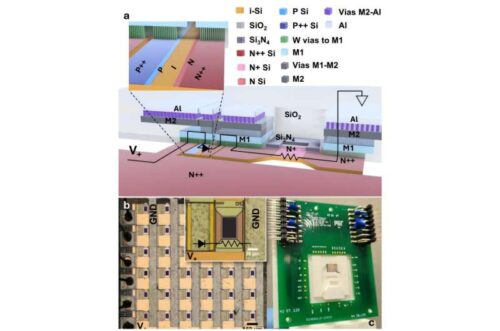
Massachusetts Institute of Technology (MIT) researchers have developed a programmable chip-based optical device that dynamically controls mid-infrared light, enabling more compact and versatile infrared cameras for detecting gases, heat and chemical signatures. The technology, described in Nature Communications, uses a pixel-level metasurface that can independently manipulate incoming infrared light without relying on moving mechanical parts.
The new system addresses a longstanding limitation of infrared imaging, which typically depends on bulky and expensive equipment. By allowing each microscopic pixel to adjust light independently, the chip functions as a tunable lens capable of changing focus and detecting multiple infrared signals within a single compact device.
Built using largely conventional semiconductor manufacturing processes, the prototype combines a phase-change metasurface with a crossbar array architecture commonly used in display technology. Layers of copper wiring and doped silicon generate heat to switch individual pixels between crystalline and amorphous states, altering how each pixel interacts with mid-infrared light. A built-in diode selector prevents electrical leakage between neighbouring pixels, making the architecture suitable for scaling to much larger arrays.
The researchers fabricated a two-dimensional 6-by-6 pixel metasurface using facilities at MIT.nano and a commercial semiconductor foundry. Tests showed the pixels could switch reliably over repeated cycles, demonstrating the durability needed for practical sensing applications. The team believes integrating the design into existing semiconductor manufacturing could help accelerate commercial development.
Potential applications extend well beyond thermal imaging. The programmable chip could improve environmental monitoring by detecting gases such as methane and propane, identify heat leaks in buildings, enhance industrial chemical sensing and support defence and aerospace systems. Researchers also suggest the technology could contribute to future optical computing, where programmable metasurfaces process information using light rather than conventional electronic circuits. Future work will focus on increasing pixel density and creating more capable systems that capture richer infrared information while remaining compatible with established chip manufacturing techniques.

