




AI’s Emissions Numbers Don’t Add Up As AI infrastructure expands, environmental reporting is becoming a traceability, methodology, and governance challenge.
Artificial intelligence (AI) is creating a strange problem for environmental reporting: the numbers can all be correct and still tell very different stories.
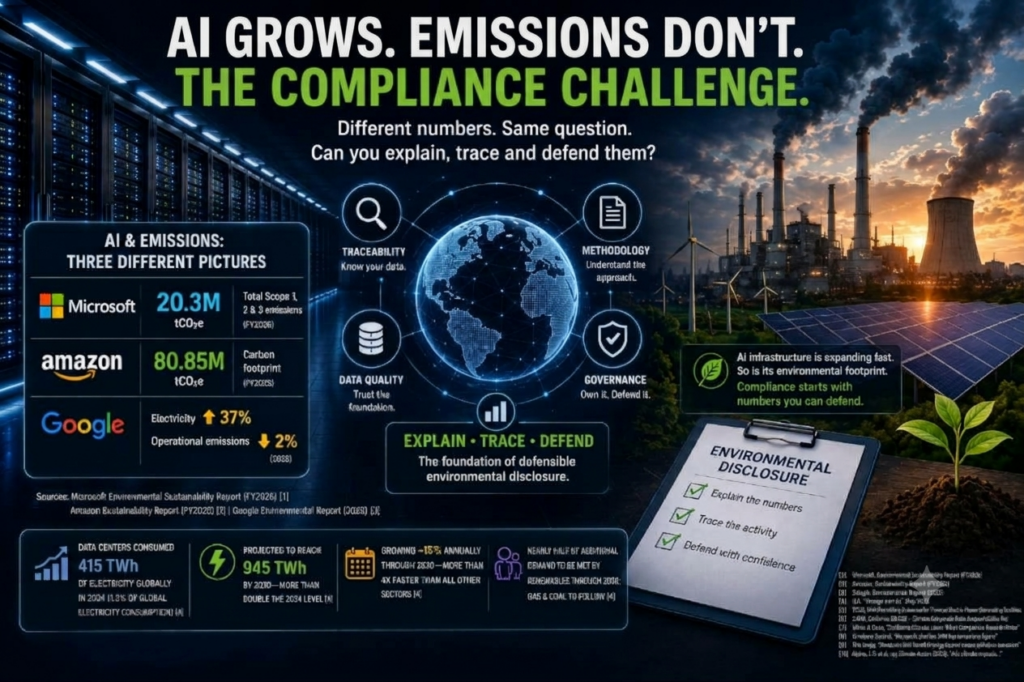
Microsoft, Amazon, and Google are expanding AI infrastructure at extraordinary speed, but their latest environmental disclosures show sharply different emissions and energy patterns. For compliance and risk leaders, the issue is not simply whether emissions are rising. It is whether an organisation can explain why the numbers look the way they do, trace them to the underlying activity, and defend them when someone asks questions.
That matters because environmental disclosure is becoming more formal at the same time that the physical infrastructure behind AI is becoming more complex.
Three companies, three different pictures
Start with Microsoft. Its 2026 Environmental Sustainability Report reports total Scope 1, 2, and 3 emissions of approximately 20.3 million metric tonnes of CO2e, an increase of about 25 per cent year-over-year. Microsoft says the increase was driven primarily by data centre expansion and changes in renewable energy procurement, while the company continues to invest in carbon-free electricity. [1]
A higher reported emissions number does not automatically mean a company has abandoned its climate strategy. Infrastructure growth, procurement choices, and accounting treatment can affect the result. The compliance question is whether the organisation can explain that distinction clearly and consistently.
There is also a lesson in how quickly emissions figures can become confused. Reporting around Microsoft’s 2026 disclosure circulated a much larger 34 million-ton figure. That figure came from a counterfactual baseline in Microsoft’s reporting, an estimate of what emissions might have been without certain actions, rather than Microsoft’s reported actual footprint of approximately 20.3 million metric tonnes. [1][8]
Amazon presents an even more layered picture. Its 2025 Sustainability Report puts its carbon footprint at approximately 80.85 million metric tonnes of CO2e, up 16 per cent from the prior year. Scope 2 emissions increased 34 per cent, Scope 3 increased 20 per cent, and carbon intensity increased 3 per cent, although carbon intensity remained 38 per cent below the 2019 baseline. Amazon also reports matching 100 per cent of its global electricity consumption with renewable energy sources for the third consecutive year. [2]
Even that 80.85 million tonne figure needs context. Amazon says its 2025 carbon emissions were calculated using a market-based method that includes Environmental Attribute Certificates. Its report says the net impact of those certificates reduced reported emissions by 199,400 metric tonnes of CO2e. [2]
That is not a reason to dismiss the number. It is a reason to ask what the number represents and how it was calculated. For compliance, methodology is part of the number. [2]
Google provides a third pattern. Its 2026 Environmental Report says electricity consumption increased 37 per cent in 2025, driven by AI infrastructure expansion, while operational emissions fell 2 per cent. Google also reported contracting for more than 12GW of new clean energy during 2025. [3]
Again, there is no single number that captures the story. Electricity use can rise while operational emissions fall, while other parts of the value chain move differently. Google reported that its supply chain emissions increased 25 per cent in 2025, illustrating why the boundary of the metric matters. [3]
The point is not to decide which company has the right emissions story. It is to recognise that the numbers need to be reconciled. None is necessarily wrong. The question is whether the organisation can connect them into one defensible explanation.
The infrastructure itself is becoming the exposure
The issue is no longer confined to emissions accounting. The physical scale of AI infrastructure is creating environmental compliance exposures of its own.
The International Energy Agency estimates that data centres consumed around 415TWh of electricity globally in 2024, about 1.5 per cent of global electricity consumption. In its base case, data centre electricity consumption is projected to more than double to around 945TWh by 2030. From 2024 to 2030, consumption is projected to grow around 15 per cent annually, more than four times faster than growth in electricity consumption from all other sectors. [4]
The IEA projects renewables will meet nearly half of additional data centre electricity demand through 2030, followed by natural gas and coal, with nuclear energy becoming increasingly important later in the decade. [4]
That means the compliance footprint can extend beyond carbon accounting to electricity sourcing, generation assets, air emissions, water, land, suppliers, construction materials, permitting, and local infrastructure.
Amazon’s planned GW Ranch Energy Centre in Pecos County, Texas, brings that issue directly back to one of the companies profiled above. The project is designed around 35 natural gas turbines with up to 7.65GW of capacity to supply a large AI data centre’s development. The associated permit allows emissions of up to approximately 33 million tons of greenhouse gases annually. [5][9]
That is a permitted maximum, not a prediction of actual operating emissions. But the scale illustrates how an AI infrastructure decision by the same company reporting an 80.85 million tonne global carbon footprint can become a major environmental compliance exposure rather than remaining an internal engineering decision. [2][5][9]
It also shows why environmental compliance cannot stop at the corporate emissions inventory. Permissions, fuel choice, local air impacts, water, land, power sourcing, and supplier information can all become relevant to the risk picture.
Disclosure is bringing the issue closer
California’s SB 253 makes the data governance challenge particularly immediate. The law applies to qualifying US business entities with annual revenues exceeding $1 billion that do business in California. It requires disclosure of Scope 1, Scope 2, and Scope 3 greenhouse gas emissions, with Scope 1 and Scope 2 reporting beginning in 2026 and Scope 3 reporting following in 2027. [6]
The timing has also been in motion. CARB initially established August 10, 2026, as the first reporting deadline. On June 24, 2026, CARB withdrew the initial regulation and associated rulemaking documents to allow limited changes. CARB later issued modified regulatory text for a 15-day public comment period, including a proposed change to move the first reporting deadline to November 10, 2026. That November date should therefore be treated as proposed rather than fully locked in. [6]
There is another reason not to treat the California climate disclosure picture as settled. The Ninth Circuit litigation challenges both SB 253 and SB 261, but the court’s injunction applies to SB 261, not SB 253. SB 253 remains in effect while the litigation proceeds. [7]
For compliance teams, that distinction matters. Regulatory uncertainty does not eliminate the need to prepare. It means organisations need a process that can adapt when definitions, deadlines, assurance requirements, or implementation details change. [6][7]
SB 253 is not an AI regulation. Its significance for AI-intensive companies is that formal environmental disclosure is arriving while the activities generating the underlying information are becoming more distributed, data-intensive, and difficult to measure.
For companies entering formal emissions reporting at this scale, the challenge is not simply producing a number; it is establishing a process capable of producing a number that can be explained, reproduced, and defended.
Even AI’s climate benefits need evidence
AI can potentially improve renewable energy forecasting, optimise grid operations, improve industrial efficiency, and enable more effective battery storage dispatch. Those benefits may be real, but they are environmental claims too, and they require evidence.
A 2026 peer-reviewed study in npj Climate Action modelled AI’s effects across fossil fuel and renewable energy pathways. Across 64 scenarios, the researchers estimated that parallel AI adoption could produce a net annual increase of 0.47 to 1.8 gigatonnes of CO2, equivalent to approximately 1.2-4.8 per cent of 2024 global energy-related CO2 emissions. In the modelled scenarios, avoided emissions exceeded enabled emissions only when renewable energy productivity gains outpaced fossil fuel productivity gains by approximately four to five times. These are modelled scenarios, not forecasts of a particular future year. [10]
For compliance, the important point is not which scenario proves correct. It is that ‘AI helped us avoid emissions’ requires an evidentiary basis just as ‘AI increased our emissions’ does.
Why this is a data governance problem
An AI-intensive organisation generates environmental information across functions that do not naturally report to the same authority.
IT understands compute capacity and workloads. Engineering controls infrastructure. Facilities track electricity, cooling, and water. Procurement holds supplier and equipment data. Finance maintains organisational boundaries. Sustainability applies emissions methodologies. Compliance may ultimately be accountable for disclosure credibility without owning most of the information behind it.
That is the operational shift.
A periodic review is poorly suited to information generated continuously across multiple systems. As environmental disclosure becomes more formal, regulators, auditors, customers, investors, and other stakeholders increasingly need data that is traceable, reproducible, and supported by evidence.
Compliance therefore has to move upstream. That does not mean taking over other functions. It means connecting them through clear expectations for data ownership, traceability, methodology, evidence, approvals, and change control.
Consider the questions behind a single emissions figure. Which facility generated the underlying activity? Which electricity data was used? Which supplier information fed the calculation? Which organisational boundary applied? Which methodology was selected? What changed from the previous reporting period? Who approved the result? Can someone reproduce it six months later?
If those questions cannot be answered without a manual investigation across multiple systems and spreadsheets, the organisation may have a reporting process, but it does not yet have strong environmental data governance.
Compliance becomes part of the process that produces environmental information, rather than simply the function that reviews it after the fact.
The question has changed
Microsoft shows that emissions can rise while climate investment continues. Amazon shows both how methodology can affect a reported emissions number and how AI infrastructure can create enormous physical exposures. Google shows that rapid electricity growth can occur alongside major clean energy investment. [1][2][3][5]
These are not separate stories. They reflect the same structural change: AI is making corporate environmental footprints more dynamic, distributed, and harder to explain after the fact.
For compliance, the question is no longer simply: What are our emissions?
It is: Can we explain where the data came from, how the number was calculated, who owns it, what assumptions were used, what changed, and whether the result can withstand scrutiny?
AI’s emissions challenge is ultimately a compliance challenge because the defensibility of the number increasingly depends on the governance behind it.
NEETA VERMA is an environmental compliance leader with 27+ years in the global electronics industry, specialising in regulatory strategy and product stewardship, whose papers have been published in Quality Magazine, Industry Today, and Maintenance World.
References
- Microsoft, “Responsibly building the AI future,” July 9, 2026, and Microsoft 2026 Environmental Sustainability Report.
- Amazon, 2025 Amazon Sustainability Report, including carbon footprint data and Environmental Attribute Certificate methodology.
- Google, 2026 Environmental Report.
- International Energy Agency, Energy and AI.
- Texas Commission on Environmental Quality, GW Ranch Energy Center permitting documents.
- California Air Resources Board, California Corporate Greenhouse Gas Reporting Program and SB 253 rulemaking and regulatory update.
- White & Case, “California climate disclosure laws: Ninth Circuit hears oral argument, no ruling yet,” January 22, 2026.
- Windows Central, “Microsoft’s emissions just jumped 25% because AI data centres are exploding in size,” July 2026.
- The Verge, “An Amazon data centre could have the worst polluting power plant in the country,” August 8, 2026.
- Alpine, W., Geldner, N., Alpine, H., & Chepeliev, M. G., “AI-driven productivity gains enable more CO2 emissions than they avoid in a global energy-economy model,” npj Climate Action, 2026.

