Beyond manufacturing, India’s semiconductor ecosystem is attracting a new wave of investors. Which parts of the value chain are drawing the most capital, and where do the biggest opportunities lie? An expert explains.
The article is based on inputs from a webinar organised by the India Electronics and Semiconductor Association (IESA) titled ‘M&A and Growth Capital Opportunities in the Indian Semiconductor Sector,’ which was presented by Gaurav Asthana, Managing Partner at Transjovan Capital. The webinar was transcribed by Shubha Mitra, Electronics For You.
India’s semiconductor ambitions have largely centred on fabrication plants, assembly and packaging facilities, and government incentives aimed at reducing dependence on imported chips. While these remain central to the country’s long-term strategy, another transformation is gathering pace. Investors, private equity firms, venture capital funds, and multinational semiconductor companies are increasingly looking beyond manufacturing towards India’s growing strengths in proprietary technologies, intellectual property (IP), and partnerships.
“The semiconductor sector is currently one of the most dynamic industries globally, and India is entering a particularly important phase of its development,” says Gaurav Asthana. He believes that the industry has reached an inflection point, driven by global supply chain shifts, government support, and rising domestic demand.
Why India is emerging as a semiconductor investment hub
Several structural factors are driving global investor interest in India’s semiconductor sector. The ongoing ‘China Plus One’ strategy, geopolitical tensions, and supply chain diversification have positioned India as a favourable investment destination.
Government initiatives such as the India Semiconductor Mission (ISM), the Design Linked Incentive (DLI) scheme, and the proposed ISM 2.0, which is yet to be approved by the Cabinet, have further boosted investor confidence by supporting domestic capability development.
“Developing a semiconductor ecosystem at this scale would not be possible without sustained government support. If we look at successful semiconductor economies such as Taiwan, Japan, and China, all of them benefited from strong policy backing during their formative years,” Gaurav adds.
Although India entered the semiconductor race later than established manufacturing nations, recent policy momentum has improved confidence in its long-term prospects. At the same time, rapid growth in electric vehicles (EVs), automotive electronics, telecommunications, defence, power electronics, industrial automation, data centres, and artificial intelligence (AI) is driving domestic semiconductor demand. India’s domestic demand alone is becoming sufficiently large to sustain significant semiconductor investments, even before considering export opportunities.
As a result, companies from Japan, Germany, Israel, and the United States (US) are actively exploring partnerships, investments, and acquisitions in India. While listed semiconductor companies continue to command healthy valuations, Asthana notes that many promising private firms remain comparatively undervalued, presenting attractive long-term investment opportunities.
Investment is also broadening beyond fabrication projects into the wider semiconductor value chain. India has long been recognised for semiconductor design services through multinational global capability centres, but Gaurav says the ecosystem is now moving towards proprietary product development.
Companies such as Kaynes, Syrma, Amber, and Dixon are steadily moving up the value chain, while the relatively underdeveloped equipment and tooling segment presents significant opportunities for Indian startups.
| Case Study: Why NXP Acquired Kinara |
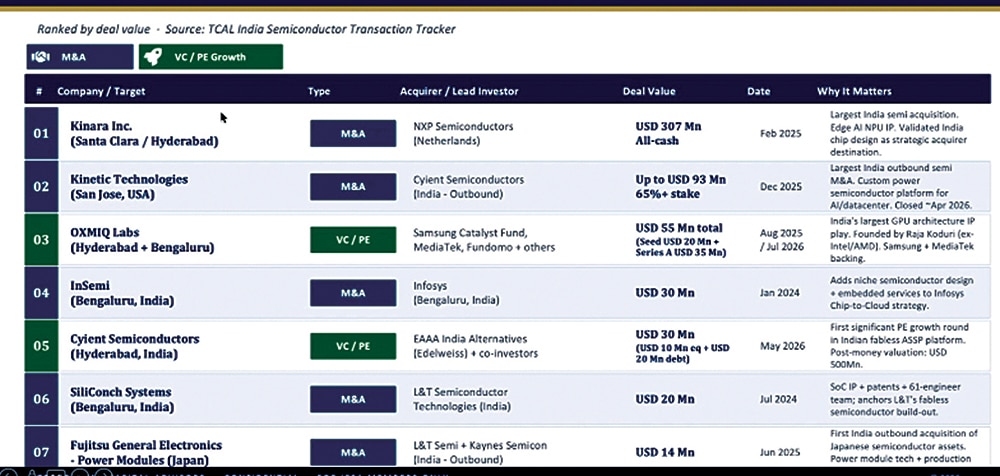
| Gaurav cites NXP Semiconductors’ acquisition of Kinara as an example of how semiconductor deals are increasingly driven by technology rather than scale. “It was not about revenue. It was about capability,” he says. Kinara’s proprietary semiconductor IP complemented NXP’s automotive and industrial technology roadmap, enabling it to acquire proven technology rather than develop it in-house. The deal highlights the growing value of differentiated products and proprietary IP in attracting investment, premium valuations, and strategic acquisitions. |
Capability, not capacity, is driving investment
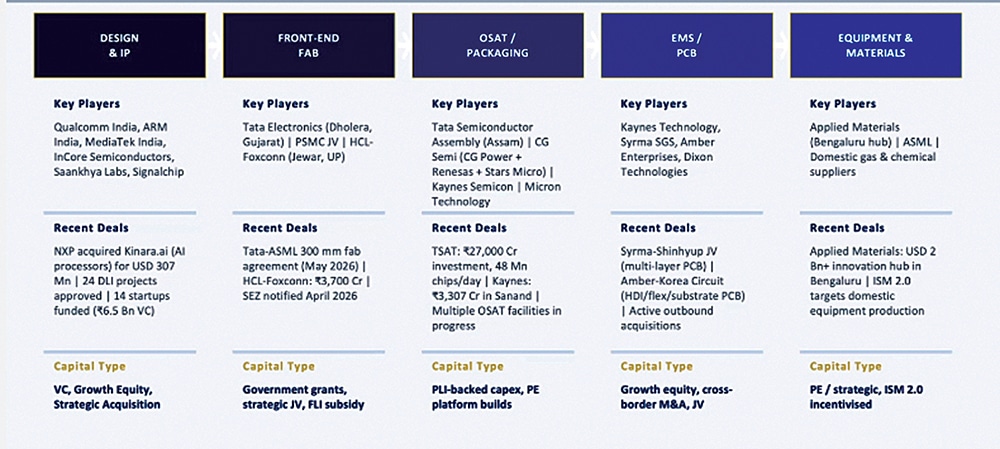
Although investment is expanding across the semiconductor value chain, different segments are attracting different types of capital. Venture capital firms, private equity investors, and strategic acquirers are focusing primarily on chip design and IP, electronics manufacturing services (EMS), printed circuit board (PCB) manufacturing, and equipment, materials, and tooling, where innovation-led businesses can scale relatively quickly.
Front-end fabrication and outsourced semiconductor assembly and test (OSAT), by contrast, continue to depend largely on industrial groups and government-backed initiatives because of their substantial capital requirements.
“These businesses require investments ranging from approximately `15 billion to `50 billion or more. Consequently, they are primarily funded by large industrial groups with long investment horizons rather than traditional venture investors,” explains Gaurav.
He highlights that although fabrication projects often dominate headlines, much of the private capital entering India’s semiconductor sector is flowing towards companies developing differentiated technologies, products, and IP. This reflects a broader shift in how investors evaluate semiconductor businesses.
“Today’s transactions are no longer driven purely by the size of a business. Instead, buyers are primarily interested in acquiring specialised capabilities, particularly in deep technology and IP,” says Gaurav.
Rather than expanding manufacturing capacity alone, investors are seeking proprietary technologies and specialised engineering expertise that can strengthen product portfolios or accelerate innovation. For India, this marks an important transition from being recognised primarily for semiconductor design services to building globally competitive semiconductor products.
“Ownership of IP has become one of the strongest drivers of valuation,” says Gaurav.
The same trend is visible in growth capital. Series A and subsequent funding rounds in the semiconductor sector typically range from US$10 million to US$30 million, depending on a company’s business model, technology maturity, and target markets. Capital-intensive projects such as fabrication plants continue to rely on patient capital from strategic investors and government-backed partnerships, with returns typically expected over 5 to 10 years.
Five deal models are emerging