

From border defence to smart cities, IoT watch towers combine AI, sensors, and cellular tech to reshape how India monitors threats and protects infrastructure.
An IoT watch tower is a smart surveillance system that leverages the Internet of Things (IoT) to monitor and secure an area. It integrates various sensors, cameras, and communication technologies to provide real-time data, automate operations, and enhance situational awareness. These towers are used in military bases, national borders, industrial plants, forests, and smart cities for surveillance and environmental monitoring.
How it works
IoT watch towers collect data through sensors and cameras, process the information using embedded computing units, and transmit it to a central monitoring system or cloud-based platform. Artificial intelligence (AI) and machine learning (ML) algorithms analyse video feeds and sensor inputs to detect threats or anomalies. Automated alerts are sent to authorities through IoT-enabled networks, ensuring a swift response to security breaches or environmental hazards.
Key Components of an IoT Watch Tower
- Sensors and cameras: Include motion detectors, infrared cameras, thermal imaging, and environmental sensors (for temperature, humidity, and gas leaks).
- Edge computing devices: Embedded processors or microcontrollers handle local data processing, reducing latency and bandwidth usage.
- Communication modules: Use connectivity options like Wi-Fi, LoRaWAN, Bluetooth, and cellular IoT (NB-IoT, LTE-M) to transmit data.
- Power supply: Towers may use solar panels, batteries, or grid connections for continuous operation.
- Cloud or local server: Data is stored and analysed for monitoring and decision-making.
Where they are applied
- Border security and defence: Used at national borders, military bases, and restricted areas to detect intrusions and unauthorised activities.
- Smart city surveillance
- Wildlife and forest monitoring
- Industrial and factory security
- Disaster management: Deployed in disaster-prone areas to monitor floods, landslides, and earthquakes, and provide early warnings.
- Coastal and marine surveillance: Monitors illegal fishing, smuggling, and environmental threats.
- Railway and transportation security
- Agriculture and farm security: Monitors livestock movement, prevents theft, and detects environmental changes.
- Critical infrastructure protection: Guards power plants, water reservoirs, and communication towers.
- Autonomous threat detection: AI-powered analytics alert personnel to suspicious activities.
Role of cellular IoT in watch towers
Cellular IoT provides long-range, low-power connectivity for real-time communication. Technologies like NB-IoT (narrowband IoT) and LTE-M (long-term evolution for machines) ensure reliable data transmission in remote areas. It supports remote access, cost-effective deployment, and scalability for surveillance. Additionally, 5G enhances performance with faster speeds, lower latency, and better device connectivity, supporting high-definition video and AI analytics.
Scenario of IoT watch towers in India
The implementation of IoT-enabled watchtowers in India is gaining traction, particularly in smart city surveillance, border security, and wildlife monitoring. These systems combine IoT sensors, AI analytics, and real-time transmission to enhance monitoring capabilities. While specific figures are limited, India’s overall IoT market is expanding rapidly, with the wearable segment growing by 34% in 2023.
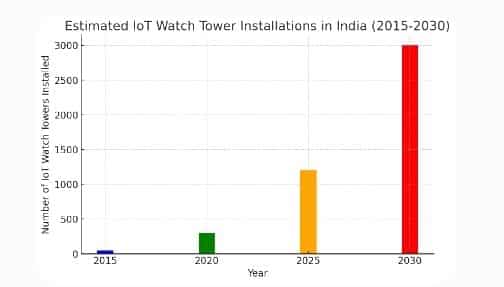
Key sectors adopting IoT surveillance include defence, where smart watchtowers enhance border protection, and environmental monitoring, which helps track deforestation and wildlife. These efforts align with India’s push toward smart infrastructure and digital governance.
Leading Indian companies like Tata Communications, Infosys, Wipro, and Tech Mahindra are investing in IoT surveillance systems. Global firms such as Bosch and Siemens also supply hardware for smart infrastructure projects. Government initiatives, such as the ‘Smart Cities Mission’ and ‘Digital India’, are driving the adoption of IoT in urban security, traffic management, and disaster response. The potential for advanced watchtowers, equipped with drones, automated detection, and AI-based analytics, is growing across both urban and remote regions.
Final thoughts
IoT watch towers combine smart sensors, AI, and cellular IoT to create advanced surveillance systems that offer continuous monitoring and rapid threat response. As infrastructure evolves, these systems will play an increasingly vital role in securing critical environments efficiently and reliably.
References
- ResearchGate
- Smart Industry
- Wikipedia
- Telit
- Statista
- Security Info Watch
Author: Vinayak Ramachandra Adkoli. The author holds a BE degree in Industrial Production and has been a lecturer in three different polytechnics for ten years. He is also a freelance writer and cartoonist.