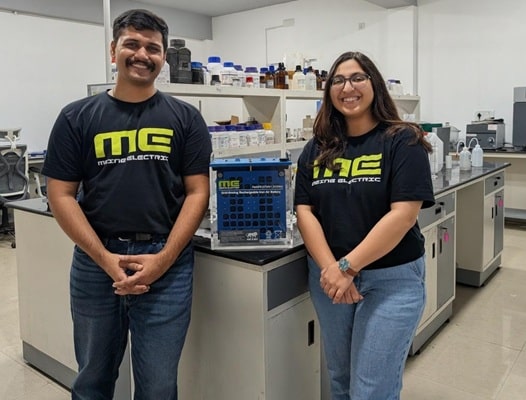
Can iron-air batteries unlock affordable, long-duration energy storage at scale? Priyansh Mohan and Stuti Kakkar of Meine Electric, in a conversation with EFY’s Nitisha Dubey, outline the technology’s innovation, cost advantages, scalability roadmap, funding support, and commercialisation plans.
Q. Could you briefly explain what your company does?
A. We develop iron-air batteries designed for long-duration energy storage. Our mission is to enable affordable, dependable renewable energy for extended periods, addressing one of the biggest challenges in the clean energy transition: effective energy storage.
Q. What makes your battery different from lithium-ion batteries?
A. Lithium-ion batteries are designed for short durations, typically 15 minutes to four hours. Our iron-air batteries are built for long-duration storage, ranging from 16 to 150 hours, making them suitable for round-the-clock use with renewable energy.
Q. How does the iron-air battery work in simple terms?
A. It works on a reversible rusting process. When iron reacts with oxygen and water, it forms rust and releases electricity. When electricity is supplied again, the rust reverts to iron, storing energy for the next cycle.
Q. Why is long-duration storage important today?
A. Solar and wind energy are not available all the time. We often generate excess power during the day but cannot store it efficiently for later use. Our battery allows surplus renewable energy to be stored and used during peak demand hours.
Q. Who are your target customers?
A. We are initially targeting energy-intensive commercial and industrial facilities with large campuses. These customers often rely on captive power or open-access renewable energy and want to reduce grid costs.
Q. What cost advantage does your system offer?
A. Our storage cost target is under ₹4 per kilowatt hour. When combined with solar generation at around ₹2.5 per kilowatt hour, the total electricity cost can be ₹5 to ₹6 per unit, which is lower than typical grid tariffs of ₹8 to ₹9 for large consumers.
Q. Is your product available in the market?
A. Not yet. We are currently in the pilot stage. We plan to deploy pilot projects within the next six to seven months and aim for larger commercial deployments around 2027–28.
Q. Do you have patents?
A. Yes, we have 11 patents filed internationally. These cover electrochemistry, electrocatalysts, and core process engineering.
Q. How is the company currently funded?
A. We are a pre-revenue company. Initially, we bootstrapped and received government grants. We have also raised venture capital funding to support research, development, and operations.
Q. Where is your company based, and how large is your team?
A. We are based in Chennai and operate from a 5000 sq ft (approximately 464.51 square metres) product development facility in Ambattur Industrial Estate. Our team has 18 full-time members across electrochemistry, engineering, automation, validation, commercial operations, and supply chain.
Q. How scalable is your system?
A. Our system is modular. We design battery skids inside container-sized units. Multiple skids can be combined to scale from kilowatt-level to megawatt-level deployments, depending on customer needs.
Q. What is the expected lifespan of the battery?
A. Our first commercial version is designed for a 10-year lifespan, similar to lithium-ion systems. Future generations are expected to last 15 to 20 years, aligning with solar project lifecycles.
Q. What are the main challenges you face?
A. The core chemistry works well, but scaling manufacturing is a major challenge. Large-format batteries require significant process engineering, automation, and capital investment. Building market awareness for long-duration storage is also important.
Q. Are you looking for partners?
A. Yes, we are open to partnerships in supply chain, power electronics, infrastructure, and system-level integration. We are also working with suppliers and regulators to build a broader ecosystem around long-duration storage.
Q. What are your future plans?
A. Our immediate focus is scaling iron-air battery technology and moving toward commercial deployment by 2027–28. We are also working to improve future battery generations and develop a software layer to enhance efficiency, scalability, and global deployment.