

Leveraging electron beam lithography, this innovative approach promises to transform the production of OECTs, opening up new avenues for their integration into technologies such as biosensors, wearable devices, and neuromorphic systems.
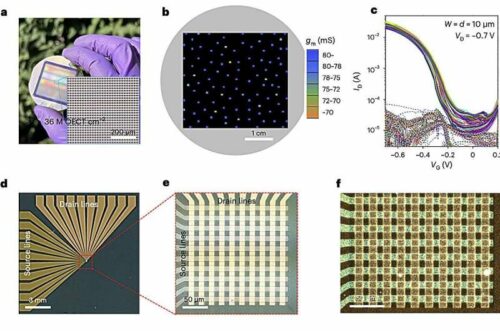
In an advancement in the field of organic electronics, researchers at Northwestern University have developed a new strategy for fabricating high-density and mechanically flexible organic electrochemical transistors (OECTs). OECTs, based on organic superconducting materials, are known for modulating electrical current in response to small changes in voltage, making them promising for brain-inspired and wearable technologies.
The research team’s approach, detailed in a recent paper published in Nature Electronics, involves the use of electron beam lithography (eBL) to pattern organic semiconductor films. This method allows for the creation of ultra-small, high-density patterns without the need for masks or chemical solvents that could potentially damage the materials. The resulting films retain their ionic conductivity while becoming electronically insulating in the exposed areas, a crucial feature for the integration of OECT structures into arrays and circuits.
The fabricated OECT arrays exhibit transconductances ranging from 0.08 to 1.7 S, transient times of less than 100 μs, and stable switching properties of more than 100,000 cycles. The researchers also demonstrated the potential of their fabrication strategy by creating vertically stacked logic circuits, including NOT, NAND, and NOR gates, which performed remarkably well with excellent operational stability.
The team mentions that this could pave the way for the scalable production of OECTs and their integration into a wide range of electronic devices, including biosensors, wearable devices, and neuromorphic systems. The new e-beam exposure strategy introduced by the team has the potential to significantly enhance the stability and performance of OECT circuits, opening up new possibilities for the development of advanced organic electronics.