




The latest infrared technology enhances vehicle safety with precise driver monitoring systems, signaling innovation in motion.
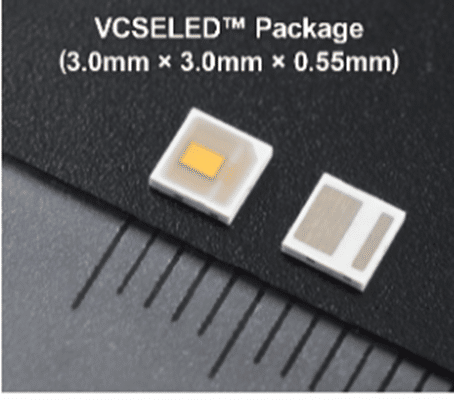
ROHM has introduced VCSELED, an innovative infrared light source technology that combines a VCSEL (Vertical Cavity Surface Emitting Laser) element with a resin-based optical diffuser for enhanced laser light dispersion. This technology is under development for commercial use, particularly as a light source in vehicle Driver Monitoring Systems (DMS) and In-Cabin Monitoring Systems (IMS).
With the growing integration of Advanced Driver Assistance Systems (ADAS) in vehicles, there is an increased installation of driver monitoring systems. These systems are crucial for detecting signs of drowsiness, sleepiness, and distracted driving. In Japan, the Ministry of Land, Infrastructure, Transport, and Tourism (MLIT) has established guidelines for the design and functionalities of these systems. Similarly, the EU plans to mandate the installation of such systems in all new vehicles starting July 2024. Automakers and suppliers are also expanding these monitoring systems to detect other occupants in the vehicle, driving the demand for high-performance light sources that enhance system accuracy.
VCSELED stands out by ensuring high-accuracy sensing due to its minimal wavelength temperature variation and broad emission beam angle. These features make it suitable not only for in-vehicle systems but also for enhancing the precision of robot inspection systems, industrial equipment, and spatial recognition and ranging systems.
Moreover, it combines the strengths of LEDs and VCSELs by extending the beam angle and incorporating both the light-emitting element and the diffuser into a compact package. This integration facilitates the design of smaller, slimmer devices while extending the sensing capabilities across a wider area with heightened precision.

Additionally, the wavelength temperature variation of just 0.072nm/°C, less than a quarter of that found in LEDs (0.3nm/°C), ensures high-accuracy sensing that remains consistent despite temperature fluctuations. The response time of the VCSEL element is also notably swift at 2ns, which is about 7.5 times faster than that of LEDs, greatly benefiting Time of Flight (ToF) applications where infrared light is used to measure distance.


