What can bat wings teach us about drones? A discovery could change how we design aerial vehicles and energy systems—learn more.
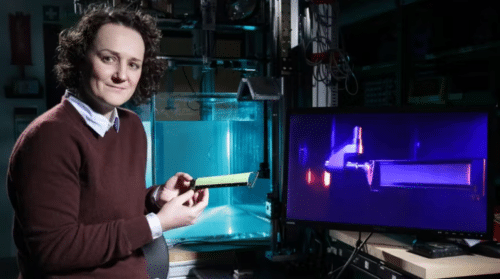
Researchers at the EPFL School of Engineering’s Unsteady Flow Diagnostics Laboratory have drawn inspiration from nature to create more efficient drones, designing wings modelled after those of bats.
The team recognized that bats hover and have deformable membrane wings, prompting the question of how wing deformation affects hovering performance. However, conducting experiments on live animals is challenging. To address this, the researchers used a simplified bio-inspired experiment to gain insights into nature’s fliers and apply that knowledge to designing more efficient aerial vehicles.
The study’s main finding was that the lift increase comes not from a leading-edge vortex, as seen in insect wings, but from the flow following the smooth curvature of the membrane wing. The researchers discovered that just the right amount must curve the wing; performance worsens if the wing is too flexible.
The team created a flexible wing from a silicone-based polymer attached to a rigid frame with rotating edges. Immersed in a water tank filled with polystyrene-based tracer particles, the researchers could visualize the airflow, something impossible with live animals. Their observations revealed that the bat-like wing showed smooth air flow instead of creating a leading-edge vortex. This resulted in increased lift and greater efficiency than an equivalent rigid wing.

Experiments allowed the team to indirectly alter the front and back angles of the wing, observing how these changes affected the alignment with the flow. Due to the membrane’s deformation, the flow did not roll into a vortex but followed the wing’s curvature, creating more lift without separating.
This finding could improve efficiency for various aerial vehicles and provide a way to create smaller drones by replacing traditional rotors with bat-like flapping wings. The team also suggests applying these insights to explore potential efficiency gains in other systems, such as wind and tidal energy harvesting devices.