These converters power everything from trains and robots to tough industrial systems and battery devices. But what makes them different? Find out inside.
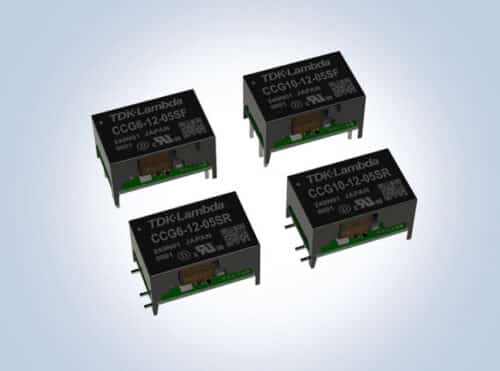
TDK Corporation has expanded its TDK-Lambda CCG series of 1.5W to 10W isolated DC-DC converters with two new options. A two-sided board coating is now available for added protection in harsh environments, such as rail and industrial applications. Additionally, a larger 40-piece tray size has been introduced to simplify placement of surface mount models.
The series includes 144 voltage and current combinations, offering 3.3V, 5V, 12V, 15V, and dual +/-12V and +/-15V outputs. Dual output models can also be configured to provide single 24V or 30V outputs. The converters support a wide input range of 4.5 to 18V, 9 to 36V, or 18 to 76Vdc, making them compatible with 5V, 12V, 24V, and 48V DC power sources. Their 4:1 input range helps simplify inventory management by covering multiple nominal input voltages with a single part number.
The 1.5W and 3W models measure 15.7 x 10.4mm, while the 6W and 10W versions are 19 x 12.4mm. The plastic case is not encapsulated, avoiding risks associated with silicone potting compounds during reflow soldering.
Single output models feature a trim function that allows voltage adjustment from -5% to +10% of nominal, compensating for PCB voltage drops. All models include overcurrent protection and a remote on/off function, which can also enable stand-by mode, reducing off-load power consumption to below 0.1W and extending battery life in portable devices.
Some of the key features of the DC-DC converters includes:
- Two-sided board coating
- Wide 4:1 input ranges
- Space-saving package sizes
- Certified to IEC 62368-1
- Reduced derating at high ambient temperatures
- No silicone potting
The CCG series operates in ambient temperatures from -40°C to +100°C with convection or forced air cooling. Input-to-output isolation is rated at 1,500Vdc. The models are certified to IEC/UL/CSA/EN 62368-1 safety standards and carry CE and UKCA marks for Low Voltage and RoHS Directives.
For more information, click here.