

The semiconductor industry is betting on this emerging technology to hoodwink Moore’s Law. Here are the basic details everyone should know about chiplets.
Table of Contents
What are Chiplets?
- Chiplets are small, modular integrated circuits (ICs) with limited functions or features.
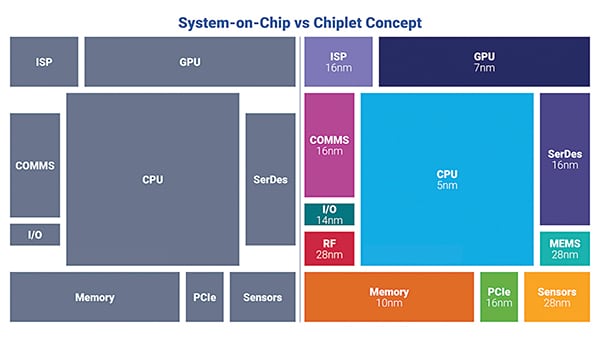
- Traditional monolithic design packs all the components into a single large piece of silicon. Chiplets separate the functionality into specialised dies, which are then assembled into a single package.
- Basically, take a system-on-chip (SoC) and break it down into its functional components—general-purpose processing, custom accelerators, data storage, high-speed input and output (I/O) communications. Now, make separate chips specialising in each of these tasks. You now get CPU chiplets, GPU chiplets, memory chiplets, and I/O chiplets, which you can put together like ‘Lego’ building blocks!
- Now what happens is that each component becomes a separate chip – which can scale to the limit of Moore’s Law. Collectively, they can surpass the limitation!
Why Chiplets?
- Reusable: The same chiplets can be reused in various devices. This increases flexibility and reduces costs and time-to-market.
- Known good die: Since the chiplets are already tested and guaranteed to be error-free by their manufacturers, the yield and reliability of the final assembly are higher.
- Heterogeneous integration: You can get chiplets from different brands that specialise in specific functions, and package them together—provided they adhere to some basic standards. It is like putting together a team of experts.
- Better optimisation: Each chiplet is typically optimised to do its function in the best possible way, with lower power consumption and better performance. If integrated properly, the final device is also super optimised.
- Flexibility and scalability: Since chiplets are modular components, they can be easily added or removed to adjust the functionality and performance of the SoC. You can also replace or customise a chiplet, without affecting the rest of the SoC. This speeds up innovation.
How are they combined?

EFY++ CONTENT: ACCESS TO THIS CONTENT IS FREE! BUT YOU NEED TO BE A REGISTERED USER.
Loading form…